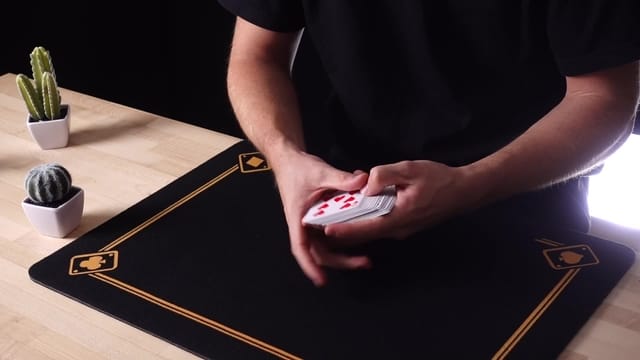
Under-spread Cull: Controlling one or multiple cards beneath the spread
The Under-spread Cull allows you to work with a card while showing the deck in an open-hand spread. Julio Ribera explains its application to place a card on top and adds a second explanation dedicated to controlling multiple cards.
Locating without stopping the presentation
The lesson places the technique in a practical scenario: you need a specific card after the spectator has shuffled. The spread allows you to show the deck and locate the card as part of an action that serves a purpose in the presentation.
Julio explains the coordination between sighting the card, establishing contact points, and continuing to pass the others. The study focuses on making the search and handling part of a continuous flow.
Maintaining the spread and controlling the card
The explanation details the support that prevents the spread from closing when a card is moved underneath. It connects the thumb's pressure, the action of the fingers carrying the card, and the space that allows you to continue passing the rest.
Closing the spread completes the control to the top. The walkthroughs show the chaining of these actions and their relationship to the appearance of showing the shuffled cards.
Adapting the move to multiple cards
The second explanation applies the Cull to more than one card. Julio discusses the blocking that the first already-moved card can cause when trying to add another, and how he coordinates both hands to continue.
He also presents another way of working: controlling a card, closing, and spreading again with a justification to repeat the resource. The lesson allows you to compare gathering multiple cards in a single spread with that alternative of separate actions.
What you need and what to practice
You need an ordinary deck and proficiency with an open-hand spread. The tutorial explains the grips and the specific movement of the Cull, but maintaining the spread's continuity and the coordination of both hands require practice.
The examples work on the single card and gathering multiple cards to the top. Mentions of false shuffles or forces describe subsequent uses; they are not full explanations of those techniques.
Julio Ribera teaches both videos. The goal is to study the location, the cover beneath the spread, and the continuity when closing, both with a single card and when adding others.