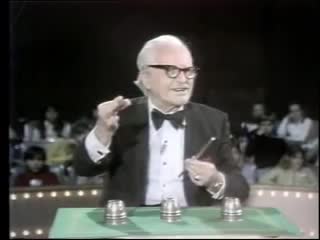
Vernon's Cups and Balls Routine: explanation and adaptation by Julio Ribera
This lesson brings together performance references from Dai Vernon and Julio Ribera's explanation of a routine based on his classic structure. The historical examples allow you to observe a presentation; the instructional videos separate the phases and discuss the teacher's adaptations.
Vanishes and first productions
The explanation begins with the preparation of the balls, the presentation of the props, and their examination at the appropriate moments. Exhibitions, loads, and vanishes are combined so that each ball appears to arrive under its cup.
Julio compares different ways to start and explains why the handling of the final vanish changes. The goal is for the repetition not to be identical, but rather to add a clearer visual image for the spectator.
Choice and assembly of the balls
A second phase introduces the choice of a cup and the travel of a ball. The explanation analyzes the different responses of the participant and the language necessary to guide the sequence.
Next, the assembly under the central cup is developed. Julio comments on a change in order regarding Vernon's reference: he prefers to group the travel ideas first and leave the penetrations for later. A simpler version with steals and another with false deposits are taught, maintaining coherence between real and apparent actions.
The penetrations
The following phase combines resources to make the balls appear to penetrate the cups. The teacher explains their progression and compares the possibilities that the props allow, without claiming that there is a single mandatory order.
Part of the sleights is reviewed as an application and presupposes knowing the basic techniques of loads, steals, and vanishes. The class does not replace all of its foundational explanations.
Building the final loads
The final block studies the apparent reduction of elements, a theatrical explanation, and the production of large objects. Julio develops a sequence with four loads, differentiating it from the three-load finale that he attributes to the reference used.
Clothing, pockets, table height, and the possibility of performing seated or standing are discussed. Some more advanced solutions, such as table lap bags, are described as alternatives; the handling shown is explained with a placement visible to the student.
Audience attention, the rest position, finger coverage, and continuity from one surprise to the next are part of the work. The sequence must be rehearsed under actual performance conditions.
Requirements
You need three suitable opaque cups, four small balls, a wand, and, for Julio's final version, four large objects that fit inside the cups. Juggling balls are used and alternatives like fruit are mentioned. You will also need clothing and workspace that allow for the chosen setup.
A branded set is not required. The content teaches this routine and its specific adaptations; other authors' performances do not mean all their methods are explained.