Glimpses and Peeks: Techniques and Card Applications
Manolo Talman presents a repertoire of glimpses and peeks to spot the identity of a card without making the observation obvious. He connects them to two main uses: revealing a card remembered by a spectator and obtaining a key card. The instruction combines simple variants, higher-coordination sleights, and complete routines using an ordinary deck.
Glimpses Integrated into Natural Actions
He explains glimpses of the bottom card during a deck turn and the top card using the bubble technique. Finger placement, coverage by the other hand, and the possibility of gathering information from both ends of the deck are examined.
The lesson also covers a glimpse during an open riffle shuffle, paying attention to the deck's position and the magician's point of view. The glimpse attributed to Hugard is integrated into a squaring gesture; he discusses how to restore the shape of the cards afterward.
Another handling allows observation during a cut or when returning the packet to the table. Arm coverage, the frontal position, and the risk of exposure from the side are compared. Simple variants involving sliding the top card are also added.
Peeks, Breaks, and Audience Perspective
The instructor analyzes why a comfortable position for the magician might hide the cards too much from the spectator. He suggests elevating the handling and reviewing what is actually visible from the front, rather than judging it only from behind the deck.
He explains how to bevel the cards and maintain a small break without creating a visible step. From that position, a one-handed fan glimpse is developed: the movement combines a turn, pressure, and opening to obtain the information while maintaining a recognizable action.
He also teaches a peek attributed to Gary Kurtz, integrated into a pressure fan. A third possibility separates the moment of looking from the moment of selection: the deck can be left on the table and consulted later, when attention has shifted elsewhere.
Verbal patter is part of the analysis. A distinction is made between asking someone to take a card and asking them to remember one they have seen. The expression «thought-of card» is worked on as the presentation for that experience; it is not presented as a freely named card without any prior procedure.
Two Applications
The first routine, attributed to Ramón Riobóo, starts with a deck shuffled by the spectator. The spectator secretly counts a packet and remembers the card at that position. The combination of the obtained information, packet management, and a false shuffle to reach the divination is explained. The study highlights the temporal separation between actions and how the memory of the effect is constructed.
The second application offers a choice between two cards after a drible. The two possible outcomes are shown: directly knowing the selection or working with a key card. The instructor compares a presentation that allows taking some risks while shuffling with a more controlled alternative based on cuts. In the variant using a key card, he explains what conditions the shuffle must preserve.
Guided Practice and Materials
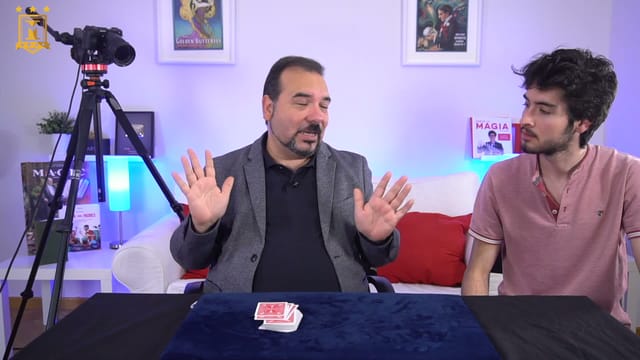
The final section reviews the peek with a student. Corrections are made regarding deck height, the bevel, the placement of the middle finger, the amount of skin maintaining the break, and the mistake of excessively shifting the packets. Afterward, the break is linked to the fan gesture, and visibility of the card is checked.
You need an ordinary deck and a table for some of the demonstrations. Familiarity with basic card handling, riffle shuffles, dribbles, and breaks is helpful. One-handed and pressure fans require additional practice, while the initial glimpses allow you to start with simpler actions.
Stacked and memorized decks are mentioned as potential contexts of use, but memorizing a stack is not necessary for the two explained applications. The practice priority is to maintain a natural action and verify the coverage from the audience's actual point of view.