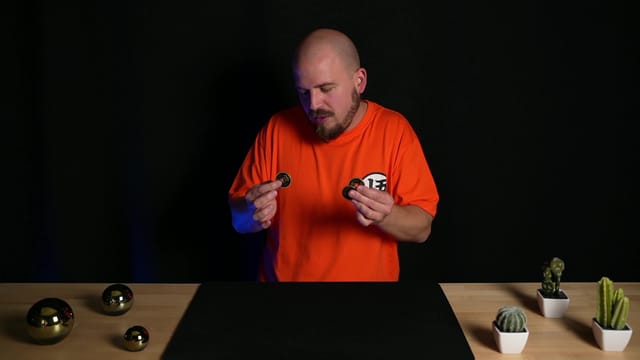
Yago Turia's Three Fly: Travels with Discards
In this version of Three Fly, the coins that have already traveled are set aside and the presentation continues with fewer elements in view. Yago Turia performs the routine and then explains the handling, subtleties, and decisions he uses to make each travel easier to follow.
Yago presents his version as an adaptation of an Eric Jones effect. He retains the idea of discarding coins along the way and incorporates adjustments that, as he explains, aim to bring more clarity to the sequence.
Preparation and Initial Display
To practice, you need four coins. The explanation begins with the layout of the coins and a subtlety that allows you to show your hands empty before starting the travels.
The transition from that display to the working position is explained. Yago connects these intermediate actions with the goal of ensuring the audience remembers a clear situation before the magic begins.
Three Travels with Different Approaches
The first travel is presented as a surprise that happens while describing the effect. Afterward, the arrived coin is set aside and the presentation of the remaining ones is prepared.
The second travel uses a softer gesture. The explanation covers the partially open hand, the necessary cover, and the coordination between the movement that gains attention and the one that loses it. Yago points out the risk of showing too much when changing orientation.
For the final travel, French Drop and a Ramsay subtlety are used within a presentation about the coin traveling up the sleeves. The patter guides the gaze toward the arrival spot and is synchronized with the moment the effect happens.
Discarding to Reduce Visual Noise
The lesson includes an extensive reflection on structure. Yago explains why he prefers to remove the coins that have already fulfilled their purpose: he wants each travel to have a clear protagonist and for the audience to see complete coins instead of overlapping fragments.
He also compares some of his adjustments with the original handling he draws from. These are explanations of his choices and the audience response he has observed while performing it, not a guarantee of identical reactions for every crowd.
Review and Closer
The tutorial ends with a step-by-step frontal review of the routine. In addition to the order of the travels, the coin display, linking actions, and final moment are reviewed.
Yago discusses different ways to gather up and finish, including an option for a seated performance. The initial performance serves as a reference for the complete effect.
The lesson employs finger palm, French Drop, cover, and attention coordination within a coin routine. It is helpful to familiarize yourself with these resources and practice the transitions; the value of the explanation lies as much in the handling as in understanding why Yago structures the three travels this way.