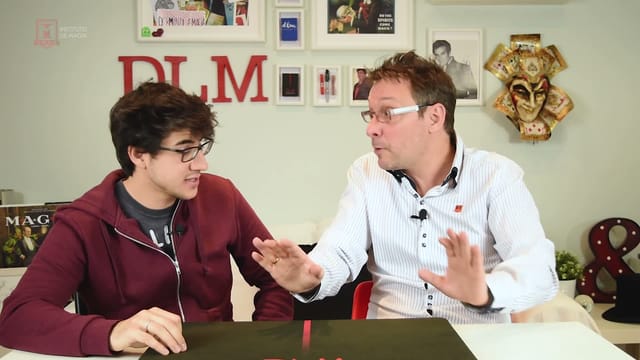
Four card magic routines and comedy principles
Four routines and the construction of their presentation
Luis Otero combines demonstrations, technical explanations, and reviews with commentary on how to present each effect. The common thread is building a situation that the audience understands, directing their attention, and saving the surprise for the right moment. The lecture concludes with a conversation on the relationship between magic, comedy, and the performer's personality.
All four routines are performed with ordinary cards. One of them adds a banknote and an appearance from the pocket; others involve the participation of two spectators, an apparent demonstration of skill, and an ace assembly with a different outcome than expected.
Card to Bill Change and card to pocket
A chosen card visually transforms into a banknote and then appears in the magician's pocket. The banknote can be signed. The preparation of the banknote, the visual change, and the handling required to complete the final appearance are explained. The moves are reviewed from different angles to understand the grips and hand coordination.
The presentation starts with a wager: making the card disappear from the fingertips and sending it to the pocket. The banknote is woven into this fiction, and a question helps shift the attention right before the change. We explore why a seemingly secondary phrase can justify what happens and give continuity to the actions.
The block also covers the gambler's palm, the alternative of transitioning to the classic palm, and retrieving the card from the pocket. It discusses how to prevent this retrieval from looking like a card that was already palmed in the hand. The effect requires careful angle management and working with an audience positioned primarily in front.
Estimation Transposition
Two spectators participate with two cards: one is named openly and the other is chosen without the magician seemingly knowing it. A thought-of number leads to a demonstration of estimation and, ultimately, a transposition between the selections. The explanation pays as much attention to the construction of the ending as it does to the technical resources.
The explanation covers the Convincing Control, a peek, the pinky count , and the Halo Cut. The count is studied as an action that can be broken down into small groups while speaking, maintaining the conversation and preventing internal counting from distracting the performer. The reviews allow you to follow the sequence and understand the function of each move.
We analyze how to divide attention between both participants, temporarily downplay one card, and present the first revelation before returning to the initial setup. An out is also provided when the count leaves an extra card, and different ways to reveal the transposition are compared. The instructor explains why he prefers a resolution based on surprise, leaving room to adapt the presentation to one's own style.
Rapidigitation
The premise of this routine is a demonstration of skill: finding a card within a spread while pretending not to look. It is performed with an ordinary, shuffled deck, and the instructor discusses how to present this apparent difficulty.
The explanation includes the peek used, the retention of the break, and an adaptation of part of the TPC, Tamariz Perpendicular Control. Mechanics' and dealers' grips, cut grips, covers, and small squaring gestures are detailed. The focus is on ensuring the hands maintain consistent behavior before, during, and after the sleight.
We study the pause between the selection and the subsequent action: recognizing where the attention lies before attempting to misdirect it. The explanation bridges mechanics and naturalness, showing the retrieval of the selection with a slower rhythm to separate the actual execution from its fast appearance.
Super Jazz Aces
Four aces and four spot cards form an assembly. The aces seem to gather progressively, but the final phase changes the direction of the effect and leads to a different final gathering than the audience expects.
The full phases, packet preparations, and their transitions are explained. The routine uses the Elmsley count, the Olram subtlety, shown doubles, and packet switches. Grips, covers, and the continuity between actions that must look identical even when fulfilling different functions are reviewed.
A specific block compares ways to execute the Elmsley count depending on whether you want to count cards or display them. Rhythm, movement, and errors that can highlight the technical moment are examined. We also discuss how to turn a packet over naturally and avoid having a presentation action involuntarily teach the audience how multiple cards are handled together.
Magic, comedy, and personality
The final conversation compares the structure of an effect to that of a joke: setup, expectations, and surprise. Luis relates the external and internal life of magic to the two layers of a comedic story, and suggests using only the necessary words so the climax is understood with clarity.
Topics include recording yourself, reviewing pauses and specific words, testing material, and working with someone capable of providing useful feedback. Developing a unique voice is approached through personal experience, audience identification, and the search for presentations that feel believable to the person telling them.
The balance between laughter and astonishment is framed around the performer's objective. We explain how a joke can relieve tension near a revelation and how that exact relaxation can be used to manage attention. Studying stand-up is proposed as a path for learning and exploration; this section is a conversation of criteria and reflection exercises, rather than a full comedy routine.
Materials and practice
You need an ordinary deck of cards, a banknote, and access to a suitable pocket for the card appearance. A marker is optional if you want to sign the selection. For table routines, it is best to have a surface with enough space to spread cards and place packets; Super Jazz Aces uses the four aces and four spot cards from the deck itself. The transposition is best practiced with two participants to work on dividing attention.
You should be comfortable handling the deck, maintaining breaks, and be willing to practice controls, palms, and counts. The explanations detail the moves used, but coordinating technique, conversation, and gaze requires rehearsal. The reviews are designed to first work on the mechanics and then integrate the pauses and presentation.