Rubik's Cube Match and Solution
A color match and two solutions
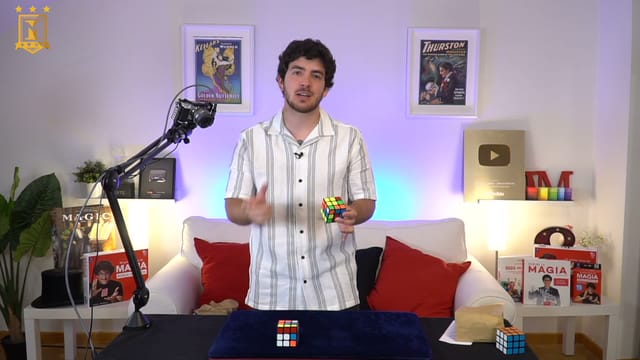
Adrián Marmac performs a routine with spectators and then breaks down its phases. The audience sees a scrambled cube, an apparent mistake while trying to solve it without looking, and a match revealed face by face. The climax returns to the initial promise: one cube is solved without looking and the other appears solved inside a bag held by a participant.
The explanation combines cube technique, prop preparation, bag handling, and presentation structure. The fast opening solution is an optional display of skill; you do not need to reach that speed to perform the routine.
One-handed technique and practice
The scramble known as "minus four" is taught, along with its setup, solution, and orientation reference points. The moves are shown separately, including single- and double-layer turns, finger placement, and alternative grips. The goal is to learn the sequence with control before executing it blindfolded.
It is also suggested to practice with both hands and work on turning the cube to recover the proper position. The explanation uses Singmaster notation and is accompanied by movement demonstrations.
An additional application is stacking scrambles: sequences are combined to produce a longer apparent mix while maintaining the necessary control. It explains how to incorporate this into the performance without reducing the action to a too brief or mechanical gesture.
Routine preparation and development
Adrián goes over the initial layout of the cubes and the bag, prop management, and a switch integrated into an apparent joke. An open bag used for the explanation allows describing the position of the items and their handling; this is not how the props should be displayed to the audience.
It explores why a conclusion reached by the spectator on their own can be more convincing than a statement from the magician. The pause, the relaxation after the joke, and the removal of props are part of that structure.
The match is presented progressively. It discusses how to make the apparent mistake understandable, keep it from dragging on too long, and compare the faces of the cubes so the audience can appreciate the result.
Final solution and participation
The class explains the handling for solving the cube inside the bag and how to coordinate it with a question or a request for help. It emphasizes acting naturally: rushing or emphasizing speed can draw attention to an action that should go unnoticed.
It also covers solving the other cube without looking, timing the separation between the two revelations, and instructing the participant. It discusses how to keep the bag closed until the right moment and ask them to take the cube out and show it to everyone.
Solving a single cube inside the bag is also suggested as a short version that can be practiced separately.
Materials and requirements
You need three smooth-turning 3x3 Rubik's cubes, opaque and flexible bags that can be crumpled, and a surface or prop table to organize the materials. The full routine uses a second bag for the finale. It is a good idea to check that the cubes allow one-handed turns and rehearse the entire layout before performing.
You must know how to solve a 3x3 and understand the basic notation for its faces and turns. The class does not teach general cube solving from scratch; it does develop the specific sequence and its magic application. Physical props are not included.
The most important rehearsal tip is to always keep the same starting orientation and run through the complete routine incorporating audience interaction. It explains how to prevent orientation errors, but does not provide an out for a cube that gets accidentally scrambled.