Hand Training, Improvisation, and Estimation in Card Magic
Learning by Playing with Cards
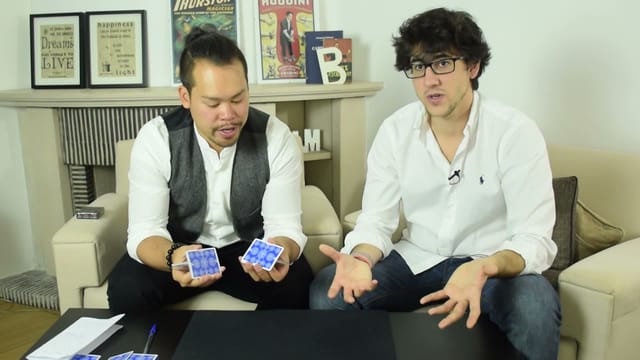
Think Nguyen presents a way to study magic based on exploring sleights, expanding resources, and enjoying practice. The lecture combines hand preparation, examples of technical research, and card improvisation. The recording includes his explanations in English and Borja Montón's translation into Spanish, who also participates in the demonstrations.
The starting point is having more options to perform with fluency. Technical knowledge, audience management, and the ability to respond to what happens during a routine are connected. The proposal invites you to experiment with a deck and observe how your hands and sleights behave.
Strength, Flexibility, Coordination, and Sensitivity
The manual preparation section organizes the work into four areas:
- Strength: finger pressures on the table, working with a soft ball, and forming paper balls. A progression of materials is proposed, paying attention to the pinky.
- Flexibility: vertical and lateral finger movements, with stretching exercises and position maintenance.
- Coordination: alternate contact of the thumb with the other fingers, simultaneous movements of both hands, and combinations in different directions.
- Sensitivity: observing touch and practicing moves to depend less and less on sight.
Exercises similar to playing a piano on the table and a guitar on the case marked with lines are added. The idea is to vary combinations, work with both hands, and recognize what feels comfortable and what needs practice.
Cardistry provides other examples of coordination and exploration. Sleights with two cards, rotations, and cuts are shown; the final section revisits several of them with slower explanations. The goal of these exercises is to become familiar with the possibilities of the fingers and combine different actions.
Exploring a Sleight
The pass serves to show how to study a technique, vary its mechanics, and explore possibilities. Think discusses cover and experiments that arose from playing with the move. The section illustrates a research process: understanding an action, modifying a condition, and observing the result.
The second deal, some passes, and advanced cuts appear as references for this approach. Their function in the lecture is to open up possibilities for study. The manual exercises and subsequent applications allow you to begin working on the proposed philosophy from different levels.
Improvisation or Jazz Magic
Improvisation is presented as a combination of knowledge, techniques, and decisions made during the performance. It explores how to take advantage of a situation without losing the thread of the routine and how to maintain a comfortable attitude while looking for a solution.
A first demonstration takes as a reference The Trick That Cannot Be Explained, by Dai Vernon. The chosen card is found again through a solution built from what happened. Timing force is discussed, along with how attitude accompanies the choice. The example allows us to observe the relationship between technical preparation and freedom to choose the outcome.
Another sequence continues the search for a card until gathering four of a kind. The use of the cull as a location and organization resource is discussed, along with the possibility of taking advantage of a moment that seems to have ended. The explanations show how a path is decided, rather than fixing a single solution for any situation.
It also reviews what happens when an estimation or initial opening does not match expectations. The examples link counts, questions, spellings, and other familiar resources to continue the routine. It is emphasized that improvising uses the performer's background and develops through experience.
Estimating Quantities and Positions
Estimation is introduced using a full deck: recognizing its halfway point, dividing packets, and comparing their thicknesses. Repeating the exercise is proposed to build visual and tactile references of different quantities of cards.
Applications include locating a selection after a shuffle, adapting a spelling, working with a requested number, and following a card when several packets are reunited. Observation, memory of information, and the use of margins of approximation are discussed. The demonstrations allow you to see both a direct hit and an adapted continuation when the path needs correction.
In spellings, you play with the available words and the approximate position of the card. The wording must be adapted to the language and the named card: the examples in the recording are performed in English, with comments on the teacher's habit of working in French.
The final application uses decisions between packets and ends with a production of the selection from the pocket. The logic of estimation and reading available information are explained; the palm and other technical resources are used as tools that the performer can incorporate into their own repertoire.
Practice and Material
The final section reviews finger exercises, coordination combinations, two card sleights, a triple Charlier cut, a brief illustration of the cull, and dividing into packets for estimation. It is designed to pause, try out, and re-observe the gestures.
You need a full 52-card French-suited deck, its card case, a table, and paper and a pencil or marker to mark the references. A soft ball or newspaper work as options for the pressure exercises.
You can start with manual preparation and deck divisions from a basic level. To develop improvisation applications, it is helpful to have prior resources, especially a force and controls; outcomes that use the cull, palm, or second deal require practice in those techniques. The proposed work consists of expanding options, testing with trusted people, and learning to adapt the path to what happens.