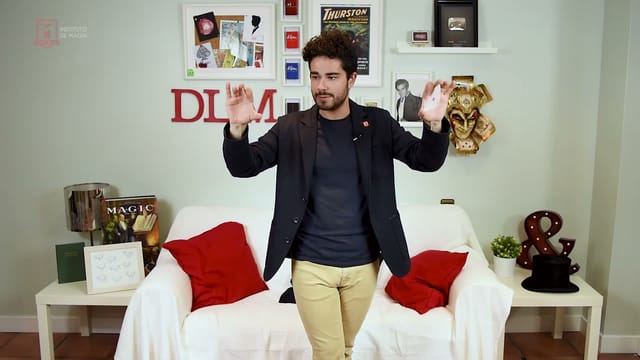
Twirling: Card Production and Multiple Appearances
From a Single Card Spin to Production
Twirling uses the rolling of a card between the fingers as the foundation for a sequence of appearances. G. Alexander first teaches this movement with a single card and progressively increases the number of cards until working with a small packet.
The masterclass distinguishes between the visible spin, which adds movement and allows the palm to be shown, and the moment of production. Each appearance must be perceived as a distinct effect, with its own accent and pause, rather than blending into the flourish.
Producing Cards One by One
The grips, the separation of a single card, its exit, and the recovery of the necessary position to continue are all studied. The explanation breaks down the work of each finger and then brings it together with the movement of the other hand.
The orientation and bend of the packet receive special attention: they affect the ease of separating a single card and what the audience can see. Control of misalignment, pressure, and the need to maintain a fluid action when receiving each appearance are also reviewed.
The slow review allows you to follow the productions all the way to showing the four Aces. For the final card, options using Twirling and Tenkai are compared, which can be chosen based on handling and presentation.
Multiple Variation and Complete Sequence
The two-handed work adds the preparation of two cards in each hand and a multiple revelation of the set of four. The grips and coordination required for both hands to act simultaneously without losing the orientation of the material are explained.
The final sequence links an opening with seemingly empty hands, the individual productions, a vanish of the packet using Tenkai, and its recovery for the multiple climax. The entry from the sleeves is briefly explained as a starting solution; the main focus is Twirling and its transitions.
The final part addresses body expression. Alexander suggests adapting gestures and energy to your own personality, aiming for comfortable movements instead of copying his performance.
Props and Practice
You need four new or nearly new cards, with edges in good condition and the bend prepared as shown in the masterclass. Aces are used so the set is easily recognizable, without requiring special cards. To replicate the opening from the sleeves, prepare wardrobe that allows for that handling.
Start with one card and add others as you master the roll. The handlings are explained in parts; familiarity with the Tenkai position is recommended to integrate the vanish and reappearance block. Afterwards, practice the reception, bilateral coordination, and the accents of each production within the complete sequence.