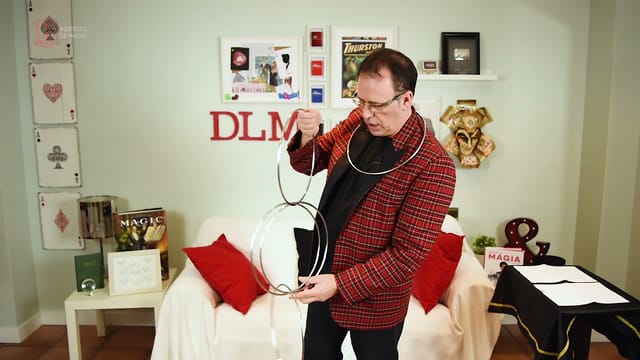
Linking Rings: six-ring routine
A routine with six rings
The class breaks down a Linking Rings sequence from preparation to the final chain. Andy González explains how to show and count the rings, link and unlink them, work with two or three, and recover the set to build figures. The sleights are studied slowly and then at performance tempo.
The introduction compares ring formats and their uses in close-up, parlor, and stage magic. Diameter, thickness, weight, and sound are discussed: the choice affects visibility, physical effort, and handling comfort. The instructor relates the size to his own working style and the audience's viewing distance.
Sleights and transitions
The explanation begins with the initial setup and the display count, including a top change to bridge the introduction of the rings into the first chain. From there, a repertoire of techniques is developed:
- Links performed by striking, swinging, spinning, and friction.
- Unlinkings featuring a slight drop and others utilizing arm movement.
- Displays that allow showing the set from various angles without halting the sequence.
- Hand-to-hand changes and resting positions on the arm or neck that facilitate continuing.
- Transformations between chains and figures, such as the globe, the four-leaf clover, and the basket.
Each technique is explained alongside the transition preceding or following it. Alternatives are also studied for recovering a chain that has dropped into an unexpected position and for linking one sleight into another without starting over.
Body, gaze, and participation
The handling involves the entire body. The gaze, turns, and height differences between the hands help maintain continuity and direct the audience's attention. The instructor emphasizes relaxing the fingers and reducing unnecessary movements, without confusing speed with rushing.
During certain phases, a spectator holds or checks the rings. The tutorial explains how to instruct them on positioning, incorporate their interaction, and bring the focus back before moving on. Practice must incorporate this coordination and the spectator's viewing angles.
The class adds complementary sleights and a continuous run-through of the sequence. For a musical performance, it is recommended to choose rhythm variations and accents that highlight important moments; for a spoken version, the movement must remain inherently clear.
Materials and study
You will need a set of six magic rings with the combination of single rings and chained rings used in the explanation. A table or stand allows setting aside some of the props, though a spectator can also hold them. Sizes are compared so you can choose one that is both comfortable and visible.
The handlings are broken down starting from the setup. It is best to practice each link, unlinking, and transition until you can perform them smoothly before putting the routine together. The explained sequence serves as a foundation for building your own presentation.