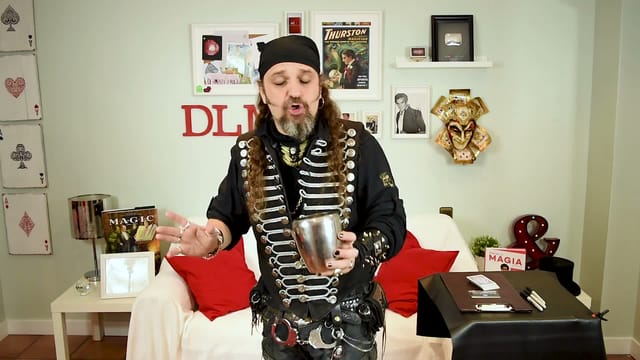
Three-thought card divination
Three thoughts and a progression
The routine brings together three spectators: one remembers a playing card, another thinks of a country, and the third of a well-known character. Each one writes their choice on a card, which is folded and mixed with the others. Greca presents a divination that progresses from the card to a finale centered on the character and their associations.
The masterclass shows the full performance and then breaks down the techniques and construction. The final outcome aims to go beyond the written data, linking it to images or characteristic elements that the spectator can recognize in their thought.
The one-ahead principle
The explanation combines the one-ahead principle with card preparation, reading, and switches. The necessary conditions to know the initial card using a stack or a force deck are studied, ensuring that the selection fits with the presentation's feeling of freedom.
Two ways of returning the cards are shown: one for tossing them toward a spectator and another for handing them out up close. The handling is broken down using different colored cards so it can be followed during study. Afterward, it is integrated into a continuous sequence, linking each move with the patter and the audience's attention.
Presentation and handling of information
Greca outlines his vision of mentalism as an experience that must be incredible while also having the appearance of an explanation. The function of references to gestures and reactions within that script is analyzed, and how a gradual revelation can set up the subsequent ones.
The class works on writing as part of the presentation: giving a reason to jot down the choices, asking for large and legible handwriting, and filling the waiting time with actions the audience can understand. It also discusses how to stay calm if a card settles differently than expected and how to continue without turning the adjustment into an interruption.
The review brings together the selection, the collection, the mixing, the revelations, and the return of the material. The clarity of the instructions and the positioning of each participant are part of the rehearsal.
Material and prior knowledge
You need three prepared and folded opaque cardstock cards as explained, writing implements, a container to collect them, and a deck of cards. You can use a stack you already know or a force deck; the class compares these options without developing a full memorized deck course.
The card switches are explained separately. It is advisable to practice them until the folding and delivery feel comfortable, and then rehearse the routine with three people to coordinate the instructions, the reading, and the presentation.