Stacked Deck: Revelations and Card at Number
A memorized deck lets you build effects where the audience recalls very clear conditions: cards cut by the spectator, a packet that gets shuffled, or a deck that stays inside its card box. Woody Aragón breaks down several applications and pays special attention to the presentation, pacing, and the instructions given to the participant.
The lesson starts off with knowing a full stack, including the associations between cards and positions. The applications are designed for different memorized stacks; learning Woody's stack is not required, nor does this teach you how to memorize the 52 cards from scratch.
Divinations and Memory Demonstration
The first section covered links a named position with the card occupying that spot. It looks at how to work after full cuts, how to mix in some simple addition, and how to chain several divinations together without losing your place.
Woody also analyzes the limits of repetition: if you hammer the same effect too many times, the audience might figure out that the magician knows the stack. He suggests leaning into that impression to turn it into a memory demonstration, speeding up the pace of the reveals and stopping before the sequence drags. The breakdown includes a presentation on seemingly memorizing packets and discusses the value of pauses, tension, and the contrast between a doubtful attempt and a confident answer.
Central Cut Location
One performance features a spectator pulling a packet from the center, remembering the bottom card of that packet, and shuffling it while the magician looks away. The explanation studies the concept Woody attributes to Simon Aronson: recognizing relationships within the learned stack even when the cards in the packet have been mixed up.
The example is demonstrated with numbered cards to make the reasoning visual and is then tied back to a regular deck. It's an exercise in retrieving positions from the cards, rather than just reciting the stack sequence. Presenting a moment of doubt between two cards serves to justify the search and set up the reveal. He discusses how to make that doubt believable and keep the focus on the participant.
Two-Deck Card at Number
The second performance wraps up with a card ending up at a named position inside a deck that was set aside in its card box. A second deck is used for choosing the card. The explanation separates the freedom of the number from the conditions of the card selection, and covers preparing both decks, keeping the stack intact, and doing the necessary locating to pull off a well-known force.
It compares searching through a table spread with handling things standing up using a fan. Woody talks about different forcing options and explains why he prefers a casual-looking choice. The lesson lets you adapt this move to whatever handling you already feel comfortable with; it doesn't build every single mentioned sleight from the ground up.
The presentation treats the climax as the magical movement of a card to a position. It examines the magical gesture, the moment to move away from the deck, and the recap of the conditions before revealing the result. It also explains how to ask the participant to remove all the cards from the box, how to guide the dealing, and how to introduce pauses so that a high number does not turn the count into a monotonous wait.
Material, Requirements, and Study
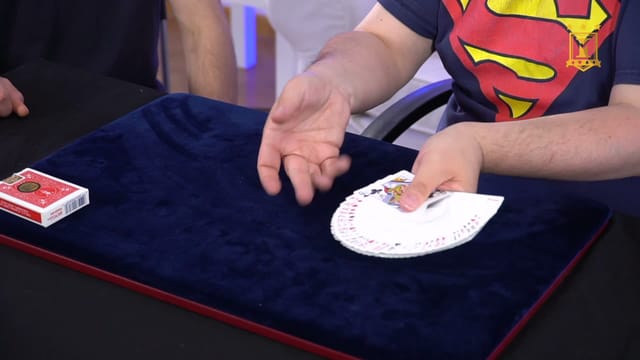
You'll need a 52-card deck whose order you know completely. For the card at number routine, you use two decks and a card box; in the demonstration, they have different colored backs to tell them apart. The numbered cards are just there to help explain things. A table makes spreads and dealing easier, though standing performances are also covered.
It helps to be handy with cuts, spreads, and fans, keep the stack intact using false shuffles, and nail at least one force with confidence. The work mixes memory, easy math, visual hunting, and audience management; preparing it takes more than just stacking the deck.
The wrap-up shares a reading list for further study: Mnemonica by Juan Tamariz; La magia pensada and Más magia pensada by Ramón Riobóo; Expert Card Technique; En orden de ilusión by Pit Hartling; and Memorandum by Woody Aragón. These are references mentioned in the recording, not materials included in this lesson.