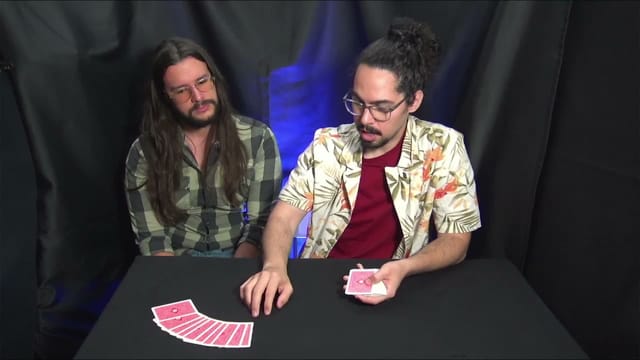
Card at a number with complementary packets
A card remembered by the spectator appears at the position they specify. Elías D’Sastre presents the effect with Alejandro, who shuffles the deck, separates a small packet and uses its number of cards to remember a selection. At the end, the participant counts to the chosen number and finds their card there. The performance leads into a complete explanation and a second example to help you understand how to adapt the procedure.
The lesson is based on the principle of complementary packets. You will learn to work with the total number of cards in the deck, calculate the required distribution and reassemble the packets to place the selection at an intended position. Elías develops the reasoning through concrete examples and shows how to maintain the pace while the spectator remembers their card. The explanation does not depend on memorising a fixed sequence of cards or using duplicates.
The handling includes two ways of introducing the number. You can ask for it beforehand and adjust the distribution to that target, or ask afterwards and adapt the position with a small cut. The explanation covers what changes in each case, how to retain the necessary information and how to present the actions so that the audience remembers the shuffle, the choice and the spectator’s participation.
You will also learn to manage the packet that the participant separates at the beginning: they can keep it or return cards to the deck under the conditions explained. Elías distinguishes when this return leaves the selection’s position unchanged and how to use it for an adjustment. This section helps you understand the principle and avoid allowing an apparently secondary action to undo the effect.
Alongside the calculations and handling, the tutorial works on presentation: questions during the deal, when to stop counting overtly, an unconcerned manner and reminding the audience what happened. It includes ideas for adapting the effect to a parlour setting and involving the spectator in the final revelation. Study references on audience memory and directing attention are discussed.
You need an ordinary 52-card deck, a table or surface for dealing and a participant. You must know how many cards you are working with and follow the procedure’s conditions; the number is requested within a suitable range, rather than as an unrestricted choice among every position in the deck. No prearranged deck or special accessory is required.
You should be comfortable with simple deals, small cuts and basic subtraction. The technical demands are accessible, but it is worth practising the conversation and pace so that the calculations and adjustments fit naturally into the performance. You receive the effect’s performance and explanation, with two examples and presentation alternatives. Ramón Riobóo’s book Magia pensada is cited as a reference for exploring the principle further; it is neither included as material nor a necessary purchase for following the tutorial.