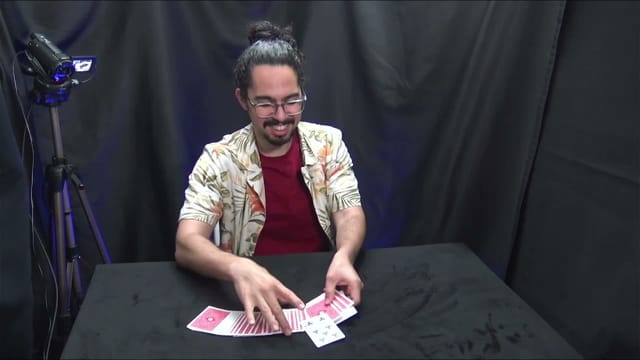
Table Triumph: shuffles, control and presentation
A selected card is lost in the deck, and the cards appear to be shuffled face up into face down. In the final spread, they all face the same way again except the selection. Elías D’Sastre presents this table Triumph with Alejandro as the spectator, then explains the complete handling, from the initial control to the revelation.
The explanation begins with exercises to understand what happens during a riffle shuffle. You will practise releasing one, two or several cards from each hand, working with the top and bottom cards and alternating groups of different sizes. Elías also explains the double cut and the importance of keeping the packets squared. These exercises prepare you for the positional control the routine needs.
You will learn the control that Elías learned from Faustino: an insertion that retains a small injog and allows the selection to be recovered with a cut. You will then study leaving an unshuffled bed of cards and using it to turn over a packet, which the teacher calls the Vernon turnover. The sequence is repeated from behind to clarify the function of the fingers, the separation between packets and the card that provides cover.
Displaying faces and backs requires care with angles and indices. Elías works on the reverse fan, limiting how far the packets open and finger positions, alongside a question that directs the spectator’s attention. The closed shuffle and double cut complete the handling and maintain the impression that the cards remain mixed in orientation.
Presentation is part of the explanation. You will see how to incorporate turning the deck over into a natural action, choose a magical gesture and spread the cards without rushing the ending. The approach distinguishes two moments: first the audience notices that the deck faces the same way; then they discover that the only differently oriented card is the selection. The recap brings the whole sequence together and explains how to give both revelations room.
You need an ordinary deck, which need not be complete, and a table or surface suitable for shuffling and spreading. You should be comfortable handling cards and devote practice to the riffle shuffle, breaks, turnover and cover. This is a technical routine: naturalness depends on coordinating the actions and controlling what the audience sees. The lesson develops the necessary handling and proposes exercises for practising it.