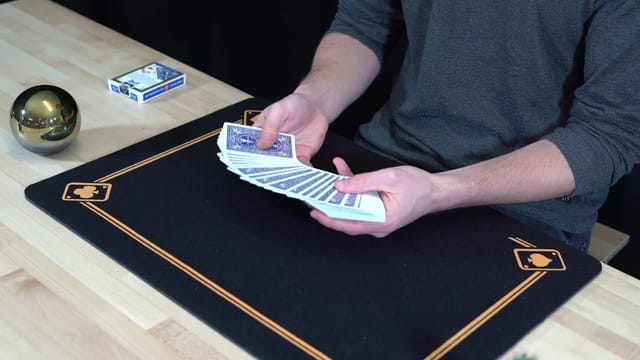
Triumph with a half double-backed deck
A genuine shuffle within a prepared presentation
A card is selected and returned to the deck. Afterward, face-up and face-down cards are seemingly mixed together, the packets are shuffled, and the spectator can push them together to complete the shuffle. A final gesture allows you to show all the cards facing the same way except for the selection.
Julio Ribera explains how to achieve this effect with a deck prepared using two types of cards. The ease of genuinely shuffling the packets depends on this setup, not on the entire deck being ordinary.
Required product and preparation
You will need cards from a double-backed deck and cards from a regular deck with the same back design. The construction taught uses roughly half a deck of each type. You can look for a double-backed deck at your usual magic shop and make sure the design matches your regular deck.
It is shown what a double-backed card is and how to combine both halves. The other special decks mentioned in the recording are not additional materials needed for this effect, and an equivalent alternative using only regular cards is not taught.
The half of normal cards is placed on top of the double-backed ones. Julio shows a slight bend of the two parts as an aid to find the break, although he clarifies that you can also visually locate the point without making that bend.
Choosing and returning in the correct zones
Before the selection, the top half can be shuffled while preserving the necessary arrangement. The card is offered for selection among the normal cards, not among the double-backed cards in the lower half.
The return is made in the area corresponding to the double-backed cards. This difference between where the card is chosen and where it is returned sets up the condition that will make the card stand out at the end.
The tutorial connects these steps with the separation of the two packets. You must preserve the orientation and recognize which half contains each type of card before starting the shuffle.
Shuffling and letting the spectator participate
One half is turned over and a riffle shuffle is performed. In this version, there is no need to fake the meshing of the packets: the spectator can push them together, and the explanation covers additional shuffles and cuts.
This intervention happens within the conditions of the setup. It does not turn every moment of the effect into an opportunity to examine every card on both faces.
Julio goes over the appearance of disorder and the moment the deck is turned over. The presentation directs attention toward the magician, with a look at the audience and a pause that separates the turn from the revelation.
Revelation and continuation
When showing the result, the selection appears as the only reversed card. That card can be handed out for inspection. The deck retains its double-backed cards and is not offered as a completely normal pack for free inspection.
If you want to continue with other routines or hand out a regular deck, Julio mentions putting away the prepared one and bringing out another normal one with the same back. This is an out that requires having that second deck ready and making the switch; it is not claimed that the gimmick vanishes automatically.
What you will learn and what you need to practice
The lesson explains the setup, the selection and return in different zones, the genuine shuffle with spectator participation, the turn covered by the presentation, and the handing out of the selected card.
It is suitable if you are looking for a Triumph version supported by double-backed cards and you can prepare that material. It is a good idea to practice locating the halves, the shuffle, and the timing of the presentation. The product facilitates certain actions while maintaining other performance conditions that the tutorial distinguishes.