Fundamentals of mentalism: presentation, preshow and pendulum
Presentation and resources for mentalism
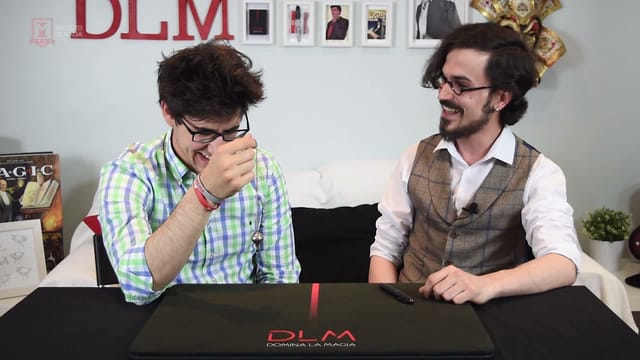
Adolfo Masyebra develops his way of understanding mentalism and turning a procedure into an experience for the audience. The lecture combines artistic theory, presentation examples, a prediction demonstration with a preshow explanation, and a pendulum exercise performed with Borja Montón. Borja acts as host and participant.
The common thread is coherence: what character you present, what the spectator can believe within that fiction, and how your words, props, and decisions relate. Definitions and classifications are presented from the professor's personal perspective. The learning focuses on illusionism and presentation resources; it does not presuppose paranormal capabilities.
Intention, ethics and audience rapport
The first part poses what you want a person to take away after participating. Adolfo compares ways of presenting an effect and analyzes the difference between causing a surprise, creating a personal experience, and simply showing that one knows information.
The treatment of the participant is developed: listening to their answers, recognizing the emotional weight of certain words, and avoiding turning an intervention into an uncomfortable situation. References to beliefs, personal losses, and readings serve to discuss responsibility and limits, not to offer clinical guidance or validate claims about someone's life.
Different attitudes toward the show are also examined, as well as how to respond without turning the performance into an argument. Attention to the person, tone, and clarity of the approach are part of the presentation work.
Resources, effects and repertoire structure
The lecture offers a map of mentalism resources: observation, suggestion, forces, cold and hot reading, memory, and illusionism procedures. Principles and examples of formulation, reaction, and interpretation are discussed. It is a comparative introduction to recognize possibilities, not a complete course in each specialty.
Starting from various effect families, Adolfo proposes varying what the audience perceives: predictions, locations, divinations, or apparent memory demonstrations, among others. The goal is to detect repetitions in structure even if the material changes.
Chuck Hickok's pyramid of credited credibility serves to order effects according to how plausible or extraordinary they are to the spectator. It studies how that progression affects the character and the construction of a show. References to calculation, hypnosis, metal bending, and other skills broaden the repertoire map; they do not include complete instruction to execute them.
Character, props and creation
It analyzes how to build a character compatible with one's own way of speaking and acting, and how to seek inspiration in theater, literature, and other arts. It is not enough to add a story: the choice of words, attitude, and type of effect must sustain the same proposal.
The prop examples develop that idea. Glasses, markers, blindfolds, crystal ball, pendulum, containers, and tarot produce different associations before starting an effect. Adolfo comments on their appearance, the information they convey, and the suspicions they might arouse. He explains why a seemingly small decision, like the design of the marker, can change the audience's interpretation.
The blindfold receives an explanation of use and handling; the crystal ball serves to show a brief technical possibility. Tarot and a deck that appears to move are used to develop a presentation. These examples do not constitute complete routines of blindfolded vision, tarot reading, or Haunted Deck.
As a creative working resource, a dynamic of ideas in brief turns is proposed: listening, recording the proposals, and developing them without demanding that the first occurrence be a finished solution.
Preshow: preparing participation before performing
A word prediction with Borja leads into the practical block on preshow, the prior work with a person before the public presentation. The function of a forcing pad is explained and alternatives with a book or cards are compared. Material preparation, manufacturing possibilities, and handling differences are also discussed.
The most developed part is the patter: justifying prior contact, giving understandable instructions, checking that the person remembers the information, and recognizing the moment of their intervention. The verbal connections that allow revisiting that experience during the performance and the conditions for participating from one's own seat are studied.
Adolfo distinguishes presentations in which the audience is informed that prior preparation took place from those in which that preparation is not part of the narrative. A card to number demonstration opens the conversation about preshow, complicity, and ethical criteria. It is analyzed as an example of presentation and method; it is not offered as a standalone card to number routine explained from start to finish.
Pendulum: demonstration and explanation
The final exercise allows following an experience with a participant and then studying its direction. A pendulum and graphic references on a card are used to work on attention, movement changes, and the progression of instructions.
The explanation covers support, comfort, rhythm, and response observation. Adolfo relates visible movement to small movements of the person and stresses the importance of granting time, without rushing each phase. The focus is on how to present and guide the exercise, in addition to the prop used.
Yes, no, and doubt responses are suggested, along with other selection or divination applications. They are brief extensions of the shown principle; references to hypnosis are not developed as a complete induction.
Materials and prior knowledge
To practice the core exercise you need a pendulum, a card or paper, and a marker. The preshow block requires the material corresponding to the chosen alternative: forcing pad, book, or cards. It is not necessary to gather all options to study presentation concepts.
Alternatives involving a deck presuppose familiarity with the chosen force. The theory and pendulum exercise are explained in an accessible way; bringing the preshow to a performance requires rehearsing the instructions, the recall of information, and the treatment of the participant.
The recording ends with a commercial presentation of blindfolds, pads, and invisible elastic thread by the professor. This is external material, sold separately: it is not included with the lesson nor is it mandatory to buy everything shown. The current availability of those products and contacts may have changed. The lesson does not include tutoring, access to groups, books, or downloadable documents.