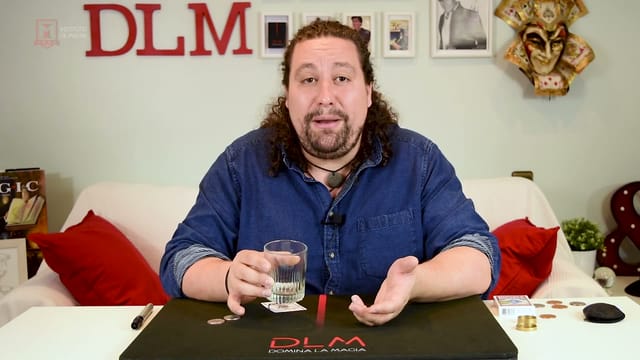
Coin and Glass Magic: The Catapult and Selective Drop
This lecture develops two main lines of coin work: the catapult and the selective drop applied to a glass. Miguel Ángel Gea demonstrates how to turn the exact same technical foundation into different effects and how to vary the handling to prevent spectators from recognizing a pattern. The performances are accompanied by explanations, practice drills, and analyses of attention, timing, and clarity.
Catapult: Technical Foundation and Practice
Gea presents the catapult as a technique by Joaquín Navajas and explains its basic position, impulse control, and hand stability. He covers tilt, cover for the movements, and preparation when handling one or multiple coins. He proposes a method for practicing hand stillness and avoiding the extra, telltale movement often used to try to assist the launch.
The work emphasizes practicing the action rather than dismissing it as too difficult, and comparing it to a natural movement. Coordination must be integrated into a normal action: picking up, putting down, or setting aside an object. The goal is to preserve the same economy of movement when incorporating the technique.
Coin Transpositions and Phase Variations
He explains a four-coin routine traveling between the hands using various applications of the catapult. The phases alter the way the coins are shown, the empty hand is displayed, and the situation the audience believes they are seeing is reinforced. This study helps understand why repeating the exact same sleight can give away clues, and how to introduce variations while maintaining a clear effect.
Another sequence uses the glass as a receptacle. Coin travels and apparent penetrations are worked on, alongside a finale built on tension and relaxation. The analysis includes the slowness of the initial action, eye contact, body movement, and the exact moment when the audience is allowed to see the result.
Brief applications expand the technique into coin changes, combinations with covert concealment, and a signed card and coin effect. This final proposal uses deck handling, a double lift, and card control; he explains the specific construction and its justification without turning it into a general introduction to card magic.
Technique Within a Meaningful Action
A metal box routine serves to study action in transit: an action gains meaning because it leads to another that is more important. He analyzes how to distribute attention and how to confirm a situation through gestures and words, rather than stopping the routine to explicitly prove it.
He also covers a variant of the French Drop and a vanishing technique based on visual conditioning. The explanation compares real movements with simulated ones and ties every detail to the overall presentation. Some combinations are offered as application ideas; not all receive the same level of development as the main sequences.
The Glass as a Technical and Expressive Element
The second section explores the glass for its transparency, its sound, and its relationship with the coins. Gea demonstrates and explains a sleight he attributes to Daniel Celma, along with its applications to a travel routine and a penetration. One variant uses Blu-Tack adhesive putty; this is a specific condition for that version, not for the entire repertoire.
A coin-through-table routine is developed, examining the dual initial setup: how to distinguish the beginning perceived by the audience from the performer's actual preparation. The explanation includes seated work, lapping, handling the glass beneath the table, and controlling the reception of the coins. This is a specific version of his work featured in La Esencia.
Another routine combines an Okito box, a glass, and a card case. The phases increase the apparent obstacles the coins must pass through, from the box and hand to the card case and table. He explains box handlings, loads, coordination with lapping, and final clean-up. He also compares ways of holding the glass that provide greater control during execution.
Selective Drop and Sound Management
The selective drop is taught within the everyday action of dropping several coins into a glass. He breaks down the gesture and works on turning its parts into a continuous action. The primary application allows for building a sequence of appearances and apparent penetrations with changes in each phase.
He examines transfers when picking up the glass, shoulder and hand relaxation, and the differences between dumping the coins and removing the glass. Sound is used both to reinforce the perception of the effect and to cover specific actions. The way objects are placed, gathered, and shown is considered part of the technique and the outer appearance of the routine.
He also analyzes how to manage the audience's perception of the number of coins throughout a sequence. The goal of this study is to understand the complete construction and its conditions, in addition to mastering each move individually.
Explained Variants and Finales
The final section combines the selective drop with other techniques and presents several applications:
- A copper and silver coin transposition, including details on bringing the coins out of the glass.
- A penetration version using a shell.
- A marker and Blu-Tack sequence, with a focus on sound and coin handling.
- A presentation based on a glass drawn on a playing card, where the fiction justifies the actions and the climax.
- An upward coin-through-table version.
- An accumulative finale featuring a glass, a small pouch, and a deck, which ends by linking a coin's journey to a chosen card.
The variants show how to combine resources and resolve different endings. Gea points out adjustments during the demonstrations and suggests alternatives depending on each performer's preferred handling.
Materials and Prerequisites
The basic equipment required is a crystal glass and four coins. Some versions use five coins; others incorporate copper and silver coins or a shell. For the corresponding applications, you will need a table and seated workspace, a close-up pad, a metal box or Okito box, a deck with its case, a small pouch, a marker, and Blu-Tack. You do not need to gather all these materials just to start practicing the catapult and the initial travels.
The specific glass and its features matter for certain applications—for instance, a frosted base is discussed. Not all sequences share the exact same angles or positional requirements either; those relying on lapping require the seated work explained.
It is helpful to be comfortable with the classical palm and finger palm, false transfers, and coordination between both hands. The catapult and selective drop are taught in depth, but some combinations reference prior techniques—such as Han Ping Chien or the Tenkai pinch—without turning each into a comprehensive scratch course. The books and publications mentioned are study references, not included materials.