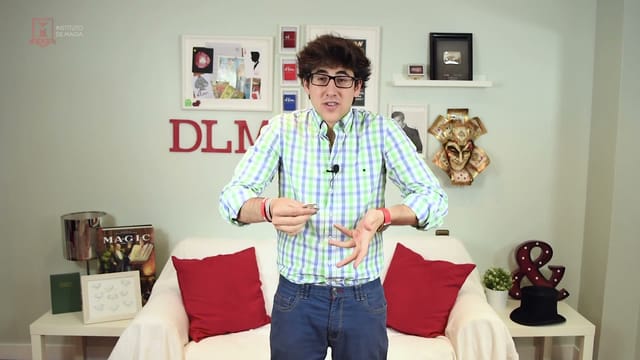
Three Fly: Standing Coin Travel
Borja Montón teaches his version of Three Fly, a routine where three coins travel between the hands. The demonstration combines fast travels, a reversal of direction, a pocket transit, and a final invisible travel. The premise of varying speeds serves as a presentational example to distinguish the phases and add variety to the routine.
The explanation is based on the Three Fly Borja learned from Daryl, combining several sleights into his own construction. The work is performed standing, without relying on a table, keeping the coins in a plane that makes it easy to follow the action from the front.
The lesson breaks down transfers, glides, tosses, additions, and false takes before integrating them into the trick. It includes the transfer Borja calls Montón and two options for resolving the final vanish. The demonstrations are accompanied by instructions on finger placement, pressure, the path of each move, and how to catch the coins.
The size of the props, friction, and sounds all influence the handling. Specific problems are also pointed out: moves that are too short, sticking pieces, grips that shift during the action, and uneven coordination between the hands. Several techniques must be practiced with both sides in order to reverse the direction of the travels.
The complete assembly allows you to study how these actions are linked with the patter. Borja works on the pauses between important moments, the continuity of the gestures, and how to direct the gaze during the final travel. The visible travel joke contrasts with the climax and is part of the routine's rhythm.
Part of the instruction is dedicated to verticality: orienting the actions toward the spectators rather than performing the moves solely for oneself. This criterion also applies to spreading cards or presenting a revelation. In this routine, it helps differentiate the working planes and allows the audience to recognize each arrival.
Identical coins are used for practice; matching poker chips are an initial alternative suggested by the instructor. An accessible pocket is involved in the sequence. Rehearsing consists of working on the sleights separately, coordinating both hands, and then bringing together the technique, presentation, and pauses without losing the naturalness of the gestures.