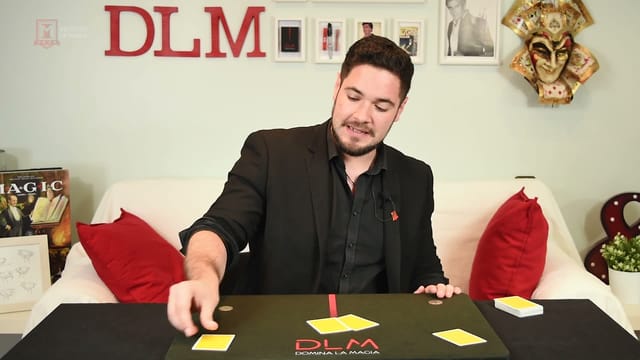
Matrix with four coins and four cards
Four coins are placed at the corners of a close-up pad and covered individually with four cards. The travels gradually bring them together in one place. Luis Olmedo presents his version of Matrix, explains the technical sleights separately, and then builds the complete routine with all its handling and patter details.
Turns and Transfers
The work begins with a steal combined with the turning over of a card. The grips, finger coordination, and a variation that allows the hand to open wider and adds lightness to the gesture are explained. The coverage of the left angle receives specific attention.
The transfer between cards is studied next: the goal is for both hands to maintain coherent gestures and for the actions of picking up, pointing, and placing the objects to make sense within the presentation. These sleights are repeated before being incorporated into the travels.
Cave, Catapult, and Sequence
The cave technique applied to the use of a single card is explained, including a variation with the hand flat on the close-up pad. The catapult is also covered and integrated into the path of the cards. The explanation combines positions and repetitions with a view of what the spectator must perceive.
The construction of the routine covers the arrangement of the four coins, the individual placement of the cards, and the coordination of both hands' actions. We study motion priority to direct gaze, relaxation, and the gestures that bring clarity to each travel.
The tempo progresses to a final phase presented with a blow and fewer actions. The review brings the sequence together and leads to a reflection on multi-phase effects: varying the audience's experience so that each travel offers something different.
Materials and Practice
You need four regular coins, four cards, and a close-up pad. The instructor uses a large surface to separate the coins and work comfortably; some positions are studied in relation to the edge of the pad.
The specific sleights are explained in the class. The routine requires precision in coin handling, control of the card grips, and coordination of both hands. It is best to practice the techniques separately first and then combine them with their cover, pauses, and tempo changes, checking the angles from the spectator's perspective.