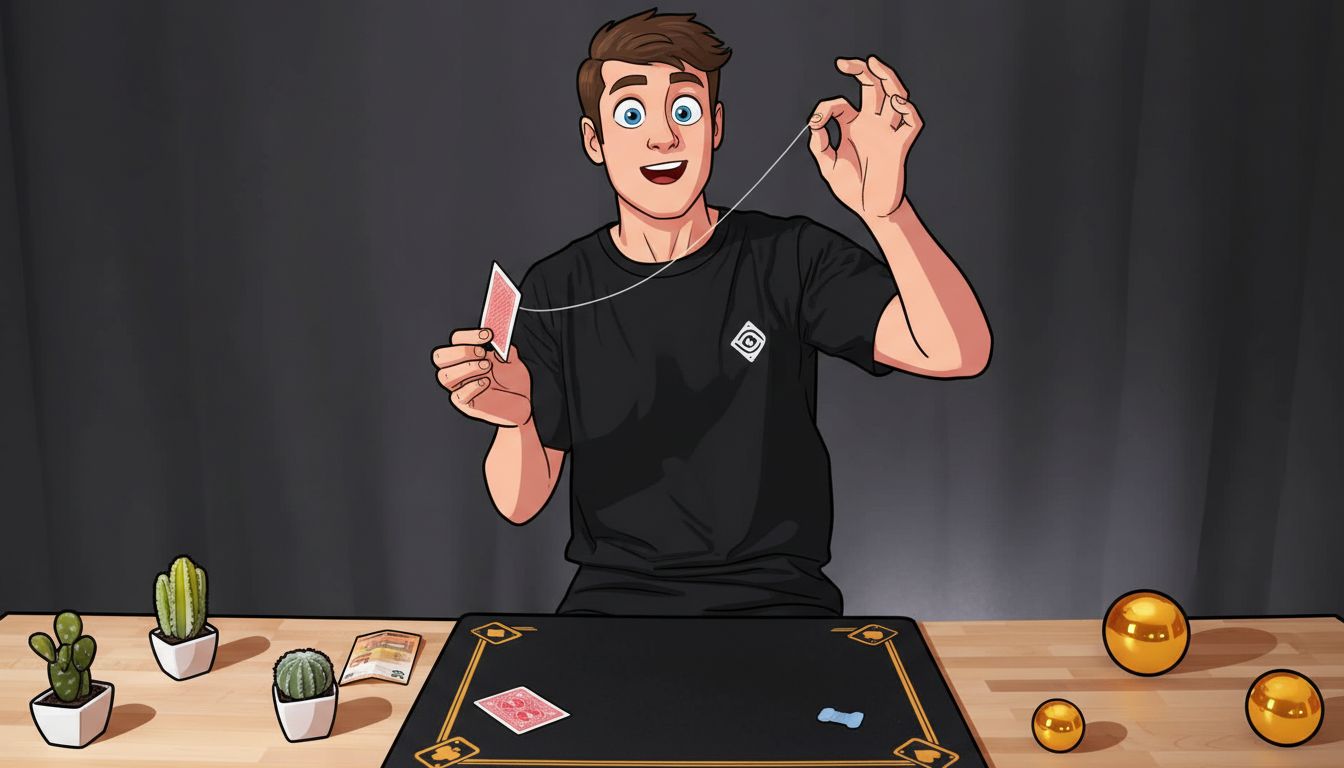
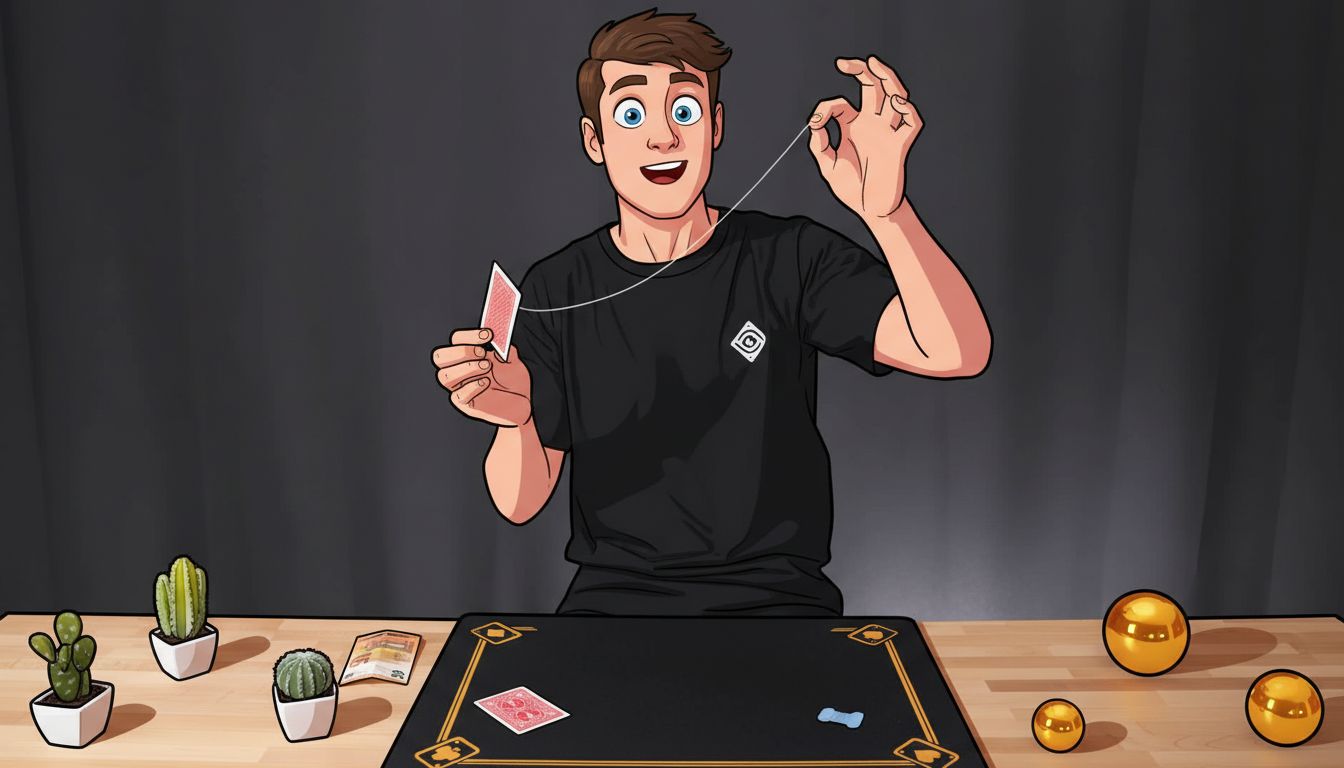
Fundamentals of thread levitation and Loops

Julio Ribera explains thread levitation systems and the foundations for using them. Five lessons and six videos cover mechanisms, preparing Loops, transport, lighting, wardrobe, and building animations.
Fundamentals of thread levitation and Loops
Julio Ribera explains thread levitation systems and the foundations for using them. Five lessons and six videos cover mechanisms, preparing Loops, transport, lighting, wardrobe, and building animations.
5 Lessons
Julio Ribera presents the tools and basic criteria for working with thread levitations and animations. The journey brings together five lessons and six videos, ranging from a comparison of systems to how to prepare the environment and build the magical moment.
The path focuses on fundamentals. Demonstrations with objects help to understand the mechanics and presentation choices; these are distinct from a complete handling routine for each object.
Comparing systems
The first lesson includes a welcome and an overview of threads, Loops, conventional ITRs, object-integrated reels, and motorized mechanisms. Thread thickness, strength, audience distance, and the weight the system can support are all connected.
Julio uses various devices to show what changes when the thread is retrieved, when the mechanism takes on the appearance of an ordinary object, or when a motor allows you to control the tension. Tarantula and the reel integrated into a marker are examples of that comparison.
Yigal Mesika's Loops appear as reference material. The possibility of making your own loops with elastic invisible thread is also discussed, meaning the course does not require purchasing all the products shown.
Understanding the principle
The next explanation makes the relationship between the thread and the object visible using white thread and a loop model. A thread with ends is compared to a closed loop.
Examples with a playing card and a banknote allow you to follow the setup of the support. It explains why, in the banknote example, the object can be removed and handed out for examination.
Preparation and transport
The preparation lesson shows the gradual process Julio calls warming up the loop. Tension and loop response are worked on, with the warning that the thread can break.
The organization of the envelope and the inner holder for carrying spares in your wallet is also covered. It shows how to adapt the size of the envelope when space needs to be saved and the usefulness of having a few prepared loops on hand.
Studying light and background
Lighting is addressed by paying attention to light direction, reflections, and the area where the thread is located. Julio explains how he looks for shade with his body or the environment and discusses indoor situations, direct sunlight, and diffuse light.
Wardrobe is analyzed as a background. The contrast of light, dark, or patterned garments is studied, along with distance and audience placement.
These criteria help assess real conditions before performing an effect. The explanation prioritizes lighting over choosing a specific garment.
Building an animation
The final lesson distinguishes the image of a suspended object from a brief movement that seems to bring it to life. Julio explains why he generally prefers small, unexpected moments to sustaining a levitation for a long time.
A marker and a banknote are used to discuss plausibility, surprise, and duration. The static electricity patter is studied as a presentation for the effect.
The explanation includes his principle of not immediately repeating the same phenomenon and of switching to a different effect if you want to continue. The work focuses on giving intention to the magical moment.
Material and starting point
Theoretical explanations can be studied before gathering the devices. To practice mechanics and preparation, you need magic-appropriate thread or an elastic loop, depending on the example, along with a compatible lightweight object.
Transport is shown using an envelope, its inner holder, and an ordinary wallet. Lighting and wardrobe are studied by observing light sources, backgrounds, and positions.
The starting point is understanding the system, recognizing the fragility of the material, and learning to control tension. Each subsequent effect will also require studying its handling, angles, and presentation.