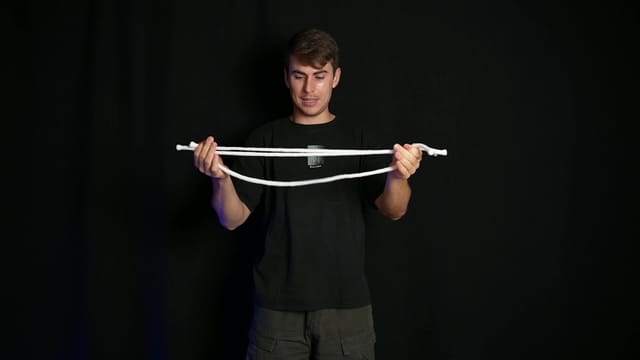
Professor's Nightmare: Classic Three-Rope Version
A short rope, a medium rope, and a long rope are shown and can be handed out for examination. Next, all three appear to become the same size, are displayed separately, and finally return to their initial lengths.
Julio Ribera includes a demonstration and explanation of the classic version of Professor's Nightmare. The tutorial develops a complete short routine with its preparation, transformation, display, and final return.
Preparing three measurements that work together
The explanation shows how to adjust the lengths relative to each other rather than fixing a single measurement valid for any situation. You can start from a comfortable length for your performing style and carry out the comparisons that Julio teaches to prepare the other two ropes.
The working size can be adapted to close-up magic or a parlor/stage setting with a larger audience. The tutorial explains the relationship between the three measurements; the detailed treatment of the ends and other preparations are referred to the specific Professor's Nightmare course.
The phases of the classic version
- Showing and gathering the ropes. Preliminary examination and a gathering order are worked on to help organize the handling during natural interaction with the participants.
- Apparently equalizing the lengths. Julio explains the arrangement of the ropes, the grip points, and the movement that produces the transformation. It includes repetitions and different angles to follow the sequence.
- Displaying the three ropes. A display is developed that maintains continuity from one rope to the next. Two ways of dividing the work between the hands are discussed so you can choose the handling you feel most comfortable with.
- Restoring the original sizes. The organization of the ends sets up the return to a short, a medium, and a long rope, completing the routine.
In addition to the sequence, details of cover and naturalness are worked on. Julio explains how to take advantage of the spectators' attention when they return the props, keep the hands relaxed, and maintain a continuous movement during the display. He also discusses the position from which the ropes are shown to the audience.
Materials, practice, and scope
You need three similar-looking pieces of rope of the coordinated lengths explained. No specific commercial magic prop is required. The preparation of the measurements and the handling of this version are taught in the lesson.
Practice each phase separately and then the transitions: gathering, transformation, display, and return. The tutorial offers handling options for the display, but does not aim to include all possible variants or routines.
Julio mentions a specific course with more phases, techniques, and variations. That reference broadens the context: here, the described classic version is taught, not the entire content of that additional course.