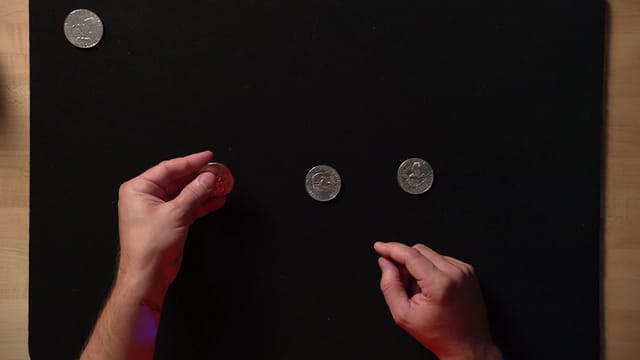
Roth's Friction Steal
What This Skill Does For You
The friction steal lets you hold back one coin while tossing a stack of others into your opposite hand. It’s a clean way to keep a coin "in play" without the audience noticing, making your coin routines look effortless. Once you get the timing down, it becomes a versatile tool for any sequence involving multiple coins.
How It's Taught
Yago Turia breaks the move down into the fundamental mechanics of the toss. You'll learn how to use your middle and ring fingers to catch the bottom coin through friction while the rest of the stack travels to your other hand. The instruction emphasizes proper hand positioning and angles so the hidden coin remains invisible during the transfer.
What Level Is This For
This is an intermediate technique. You should have basic familiarity with holding and tossing coins. Because it relies on the physical "catch" of the coin, it requires practice to develop the right amount of pressure. It’s not about strength—it’s about the natural toss and the follow-through of the hand.
About the Instructor
Yago Turia is a specialist in close-up magic with a focus on practical manipulation. He is known for providing clear, step-by-step breakdowns of classic sleights, making complex coin work accessible for those who want to refine their technique.
What's Included
- The mechanics of the friction steal for multiple coins
- Techniques for using dollar or half-dollar sized coins
- Managing hand angles to keep the stolen coin hidden
- Variations for tossing and dropping coins
- Advice on ambidextrous practice for both hands
Frequently Asked Questions
How long until I can use this in a routine?
If you practice the motion consistently, you can get the basic catch down in a few hours. The "invisible" part—where you make the move look natural—takes a bit more time to smooth out.
What if I have small hands?
This move works with the size of the coins rather than the size of your hand. Whether you use half-dollars or silver dollars, the key is the position of your middle and ring fingers.
Do I need special coins?
No, you can use regular coins. Practice with what you plan to perform with.
Can I learn this without a teacher watching?
Yes. Since the move relies on the angle of your hand, you can easily check your progress by practicing in front of a mirror to ensure the coin isn't exposed when your hand turns.