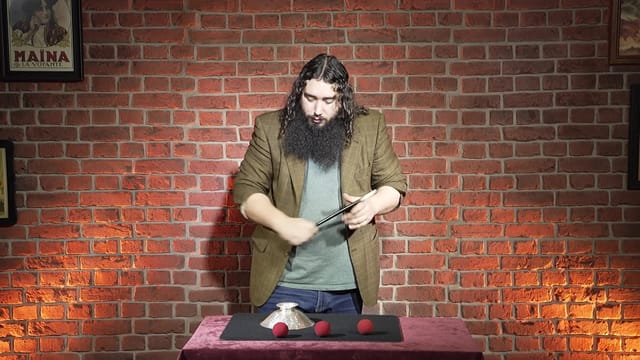
Roy Benson's Bowl: Xulio Merino's Version
From the Bowl to the Spectator's Hands
This version of the Roy Benson bowl links three travels, spectator involvement that changes the destination of the balls, and a deck finish. Xulio Merino demonstrates the sequence in two videos and explains the handling in a third.
The key is ensuring that each vanishing has a distinct appearance and the moves flow smoothly together. The routine uses three visible balls and one extra.
Three Travels with Different Actions
In the first section, the balls vanish from the hand and successively appear under the bowl. Xulio applies the Vernon-style false transfer, visual retention, and the delicate retrieval to vary the look of the vanishes.
The explanation covers ways to lift, tip, or transfer the bowl, hand-to-hand changes, and body shifts. The magic wand and prop actions provide continuity for the loads and revelations.
A Change of Destination
After the travels to the bowl, the spectator is brought in. The patter announces another arrival beneath the vessel, but the result is found in their hand. The sequence continues until all three balls are gathered there.
Xulio explains the instructions and the choice of the spectator's position, along with the moment of relaxation following the opening of the hand. These details connect the interactive finale with the setup for the final appearance.
The Final Deck
The climax produces a deck of cards under the bowl. The explanation breaks down the load, cover, and hand-to-hand change needed to achieve this result. From there you can end or transition into card magic.
The taught version focuses on these travels, the interactive phases, and the deck. The work aims to integrate every move into a fluid sequence rather than presenting the sleights as isolated actions.
Props and Setup
You will need a bowl, a wand, four sponge balls, and a deck. Xulio clarifies that a standard bowl and wand work fine for this version; he does not use the special properties of the model he displays.
The performance is done on a close-up pad, and the explanation uses pockets to organize the loads. It helps to be familiar with finger palm, the Vernon-style false transfer, visual retention, and delicate retrieval, which are applied here to the choreography of the routine.