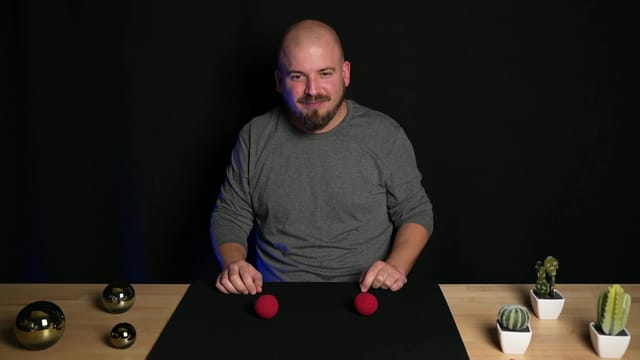
Sponge Travel Routine
What This Skill Does For You
This routine lets you perform a clean, visual transposition where sponges travel from your hand to a spectator's closed fist. By using a simulated "mistake" as a cover, you create a natural moment of misdirection that makes the difficult part of the trick invisible to your audience.
How It's Taught
The lesson breaks the routine down into two parts: the practice drill and the performance. You'll learn how to use a "false correction" to hide your moves. Yago explains how to manage the focus of the spectator's eyes so that even if your sleight isn't perfect, the magic still registers as a success.
What Level Is This For
This is perfect for beginners. You don't need years of experience, just a willingness to practice the false transfer until it feels natural. If you have a pair of sponge balls, you have everything you need to start.
About the Instructor
Yago Turia is a specialist in sponge ball manipulation. He focuses on practical, real-world magic that relies on clever misdirection rather than overly complex finger work.
What's Included
- The "false correction" technique to hide your moves
- How to use spectator confusion as a form of misdirection
- A physical drill to build fluidity in your transfers
- Tips for controlling the spectator's hand position to prevent premature reveals
- The "toss" pantomime to sell the effect of the travel
Frequently Asked Questions
How long until I can perform this?
You can learn the mechanics in one session, but practice the "mistake" drill for a few days so you don't look like you're thinking about the move while performing.
What if I have small hands?
Sponge balls are perfect for any hand size because they are compressible. You don't need to palm them in a traditional way; you just need to hide them momentarily.
Do I need special sponge balls?
Standard, soft sponge balls work best. They are easy to compress and make the vanish much more convincing.
Can I learn this without a teacher watching?
Yes. The tutorial explains the exact focus points. Use a mirror or your phone camera to check that your "mistake" looks like a genuine correction to an observer.