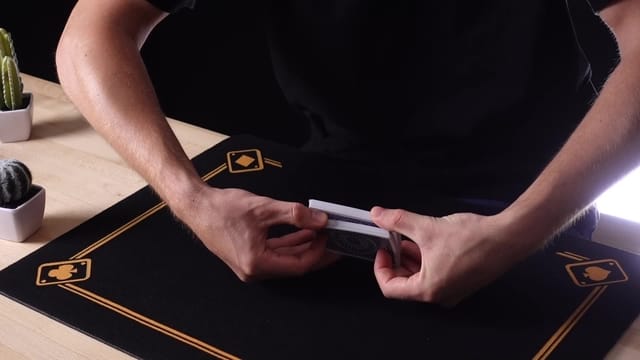
Table Riffle Shuffle
How the Table Riffle Shuffle Actually Works
Most people think a shuffle is just about mixing cards. The real secret to a clean table riffle is in the grip. By using your middle and ring fingers to anchor the corners and your thumbs to handle the split, you keep the deck stable and look like you know exactly what you’re doing.
Why This Changes Things
When you shuffle in your hands, it’s easy for cards to slip or for the shuffle to look messy. Moving to the table makes your movements feel deliberate and professional. Once you get comfortable with the diagonal angle—where the packets lean toward each other rather than standing straight up—the cards will weave together naturally. You’ll stop fumbling and start creating a smooth, consistent riffle that looks effortless.
What This Content Covers
This tutorial breaks down the mechanics of the table riffle into small, manageable steps. You’ll learn how to split the deck cleanly using only your thumbs, how to position your fingers for maximum control, and how to use your index fingers to apply the right amount of pressure for a perfect weave. The teaching is direct, focusing on the physical placement of your hands so you can practice without guessing.
About the Instructor
Julio Ribera is a Spanish magician and content creator with over 1.5 million followers. He has spent years refining the fundamentals of close-up magic and sharing them through his online school, Magigram, with a focus on teaching practical skills through real-world application.
What's Included
- Proper finger positioning for table-top control
- The thumb-split technique for clean packet separation
- Adjusting packet angles for smoother interleaving
- Applying index finger pressure for a consistent riffle
- Methods for squaring the deck after the shuffle
Frequently Asked Questions
Is this theory or practical?
This is purely practical. It’s a mechanical skill you can practice while watching the video.
Will this work with decks I already own?
Yes, this works with any standard deck of playing cards.
How detailed is the explanation?
The lesson focuses on the specific finger placement and the angle of the packets, breaking down the movement so you can replicate it exactly.