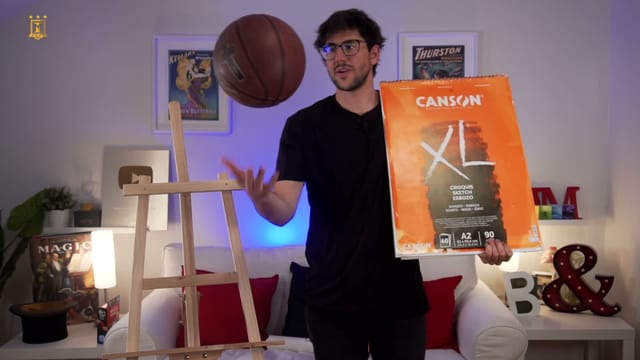
Basketball Production from a Sketchpad
From Drawing to Real Ball
A basketball drawn on a sketchpad appears as a real object while the drawing vanishes from the page. Borja Montón explains his basketball adaptation of Kevin James's classic bowling ball effect. He demonstrates the handling and details of the custom-built prop, including an easel that allows the pad to be displayed upright before picking it up.
Choosing the Object and Presentation
The impact of a bowling ball is compared to that of a basketball: the weight, the sound of the drop, and the connection to the patter alter the perception of the effect. Borja explains why he chose basketball for a performance and how to integrate the drawing of a hoop and the production into a theme recognizable to the audience.
He also demonstrates Gustavo Raley's Super Pad as a more compact option for smaller objects, such as a glass or a can. Its handling and limitations are discussed; it is not presented as a version where the drawing vanishes.
Handling, Angles, and Prop Clearance
The explanation covers how to hold the pad, draw, produce the ball, and subsequently show the page. Precise and controlled movement is practiced to avoid jerky motions that might reveal what should remain hidden.
Side angles require special attention. The tutorial examines how to angle yourself, use your body and arm, and maintain a consistent position during the drawing and the production. This routine is not designed for surrounded working conditions.
The handing off and clearing of the pad with an assistant are also explained. These actions must be rehearsed from the actual audience viewpoints, along with the timing of the production and managing the ball onstage.
Pad and Easel Preparation
Borja compares a metal construction with his birch plywood version and demonstrates the arrangement of covers, pages, and fastenings. He discusses how to adjust the prop to prevent visible warping, check the finishes, and reduce the accidental exposure of a brightly colored ball.
Two options are presented for the drawing: erasable pages or standard refill paper. The text explains why the background tones of the pages must match and what issues marker residue can cause.
The easel is an optional adaptation. The lesson shows how he modified it using wooden elements, a hinge, and Velcro, and how he organizes the placement and removal of the pad. These are details of his specific build, not a kit or scaled blueprints for any model.
Materials and Practice Required
You will need a basketball and a production pad—either purchased or built for that specific object. The featured adaptation uses a large sketchpad, birch plywood, straps, and fasteners; for the drawing surface, paper or an erasable board and a compatible marker. The easel version includes the stand and its adaptation parts.
The wooden model shown is designed for a basketball; working with a bowling ball requires apparatus suited to that weight. This lesson does not replace the full instructions of Kevin James's original product. Physical equipment is not included.
Basic stage performance experience is recommended, as well as the ability to adjust and finish the pieces if you build the prop yourself. The handing off and clearing explained rely on an assistant; a complete solo alternative is not covered. Practice the handling with the actual props and verify their operation and visibility before performing. The production of an orange with the vanishing of the drawing is only mentioned as a reference and is not taught.