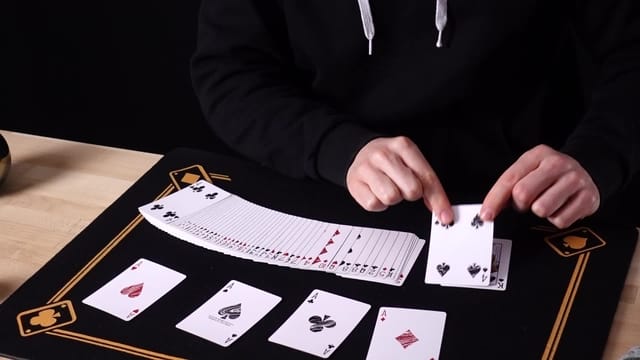
Ace Assembly Setup
What It Looks Like
You start with a borrowed, shuffled deck and openly remove the four aces. While the audience thinks you are just finding the cards, you are secretly arranging the deck. By the time you finish your brief setup, you have a specific card in the second position that lets you perform a clean, convincing ace assembly.
Why It Works
This method relies on "culling" or rearranging cards while the audience assumes you are just looking for the aces. By choosing a number between 3 and 7 to act as your "indicator" card, you simplify the counting process at the end of the trick. It turns a complex-looking arrangement into a natural part of your opening routine.
What You'll Learn
This lesson breaks down the exact sequence of cuts and breaks needed to control the deck. You’ll learn how to handle the deck to keep the audience focused on the aces while your fingers handle the technical work underneath. Julio explains how to use double undercuts and breaks to move the cards into the right spots without looking suspicious.
About the Instructor
Julio Ribera is a popular Spanish magician known for his practical approach to card magic. He focuses on teaching routines that work in the real world, prioritizing clarity and efficiency so you can perform miracles without looking like you're working too hard.
What's Included
- How to handle a borrowed deck for an impromptu assembly
- Techniques for culling cards while searching for the aces
- Using double undercuts to position cards
- Managing breaks with your pinky and index finger
- The "indicator card" principle to streamline your counting
Frequently Asked Questions
What angles work best for this?
Because you are working with the deck in your hands, it is best performed at chest or waist height. Keep the cards tilted slightly toward you to hide the breaks.
Can I do this surrounded?
It's designed for close-up work. If people are standing directly behind you, you’ll need to be careful with your finger movements during the cuts.
Do I need any special props?
No. This is completely impromptu and works with any standard deck of cards.
How much practice does this take?
The moves are standard sleights. If you are comfortable with a double undercut and basic deck control, you’ll be able to get this down in a few practice sessions.