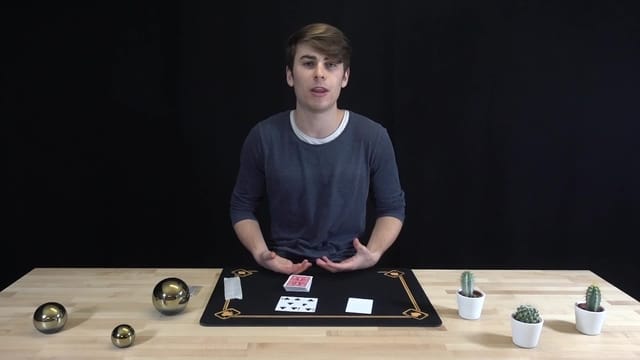
The Vanishing Ink: Transfer and Signed Card
Ink is presented as the identity of each card. First, it seems to travel between a blank card and a printed one. Afterwards, the effect expands to the entire deck: the faces remain blank except for the card the audience has signed.
Julio Ribera brings together the performance and the explanation in a single video. He teaches the setup, the two linked effects, and the presentation that turns the signatures into the dramatic reason for the conclusion.
The Initial Transfer
The first part introduces a blank card that the audience can examine before the ink appears to travel. One card changes its appearance while another is held between the participant's hands.
The explanation covers the arrangement of the cards, the use of the duplicate, and the application of the Double Lift. It also connects this handling to the classic transposition used as a starting point.
You will learn how to give a function to this introduction: establishing the theme of ink and preparing the audience for a larger-scale effect. The tutorial does not present the two phases as unrelated tricks.
The Signed Card as the Core of the Story
In the second phase, a card is chosen and signed while the magician has their back turned. Julio explains why it is important to give the instructions before turning away and how to use the attention generated by the signature.
The clarity of the instructions is studied: making sure the face is signed, that the participants remember their card, and that it is left face down before continuing. That participation builds the difference between the selection and the rest of the deck within the narrative.
The Deck Switch and Its Presentation
The instruction covers a deck switch using accessible pockets and misdirection. Julio discusses how a jacket or a garment with deep pockets helps and allows you to use any other switch you already know.
The work includes body positioning, patter, and how to regain the continuity of actions. The explanation shows a simple handling, but its cleanliness requires rehearsing with a real audience.
Next, it explores how to let the participants get involved in returning the card and during the final check. Their role is integrated into a sequence prepared by the magician.
The Fire Climax and the Blank Faces
The recorded version incorporates a flame as an image of the vanishing identities of the cards. Julio explains the use of paper from a tea bag for that moment.
The subsequent reveal shows the disappearance of the face printing, with the signed selection as the exception. The cards do not physically vanish: their appearance changes within the effect.
The story of souls and ink belongs to the presentation. The learning focuses on the construction of the routine, the props, and audience management.
Specific Props
You need a blank-face deck with normal backs, a standard deck, and a duplicate card with matching backs, plus a card case and a marker. In the recording, Julio uses Bicycle cards and discusses standard deck options from that brand. You can find the blank-face deck at your usual magic shop.
The explained handling requires accessible pockets for the deck switch. To recreate the recorded climax, a tea bag paper of the type shown and a lighter are also used; the explanation does not use flash paper.
This routine requires preparation and specific props. It is advisable to know the Double Lift before studying its application to the transfer; the deck switch and its context of misdirection are indeed covered in the tutorial.
Julio Ribera is the instructor and presents the routine as the result of his own creative challenge. The lesson allows you to study how he connects an initial effect, audience participation, and a finale featuring the signed card.