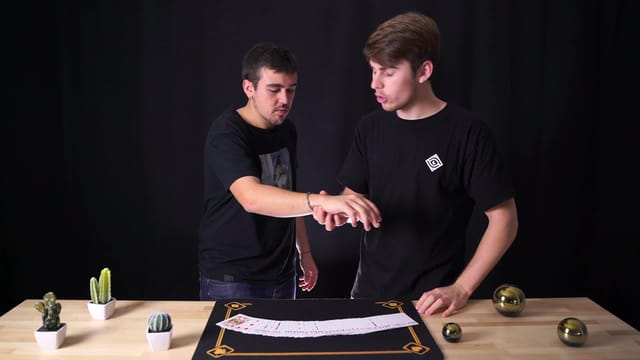
Pulse Reading: Key Card, Patter, and Revelation
The spectator shuffles an ordinary deck, selects a card, and returns it while the magician's back is turned. After several cuts, Julio Ribera takes their wrist and frames the search as if he could locate the card thanks to their pulse. The selection is narrowed down until only a single card remains.
The lesson combines the performance with an explanation focused on the key card and misdirection/staging. The apparent pulse reading is the magic plot: the taught method uses card information and attention management.
Comprehending and placing the key card
Julio explains what a key card is and how it serves as a reference to locate the selection. He expands on the relationship that must be preserved when returning the card and shows why cutting and completing a cut maintains the desired order.
He also covers the case where a cut momentarily separates the two cards between the ends of the deck. He distinguishes that type of complete cut from various shuffle actions that could undo the necessary relationship. The freedom of subsequent handling is not presented as an arbitrary shuffle without conditions.
Obtaining the information when receiving the deck
The explanation shows how to learn the reference card when the spectator returns the shuffled deck. If it is not seen upon receiving it, Julio discusses a slight twist between grips and a hand-opening gesture as alternative ways to perform the peek.
The focus is on integrating that action into a meaningful conversation and avoiding treating it as an isolated moment. The lesson develops both the principle and its application within the performance.
Making the selection clear
Julio explains why he turns his head away, asks for the card to be shown to the audience, and has it turned face down. He also discusses the instructions and gestures that accompany the participant's cuts.
These are details that build the illusion that the performer has not seen the chosen card. The clarity of those instructions is also important so that the participant performs the type of cut the procedure requires.
Building the pulse search
The explanation connects the ribbon spread on the table with the location of the card and the narrative of a search through sensations. It examines when to take the wrist, how to pretend to eliminate areas, and how to introduce doubt before approaching the finale.
Julio develops a reduction down to four cards and a final phase with the cards face down. He explains how to track the selection during that handling and how to maintain the flow of the search up to the revelation.
The fiction does not equate to reliably measuring a pulse or diagnosing emotions or lies. The teaching deals with a card magic routine, without any medical or scientific claim about the participant.
What you need and what you should practice
You need an ordinary deck and a table or surface that allows for a ribbon spread. Neither a marked deck, a pulse-reading device, nor a commercial magic trick is required.
The explanation introduces the concept of a key card and its peeks. It is helpful to be able to handle the deck and perform a ribbon spread; the latter is used within the routine without turning the lesson into a comprehensive spread course. Study work combines instructions, memory of a reference, handling, and presentation. Julio Ribera is the instructor.