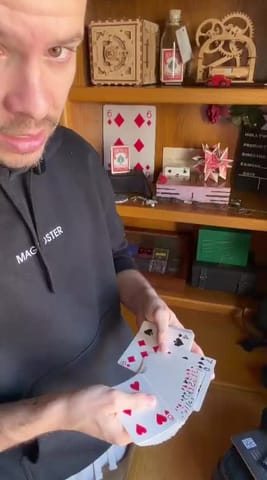
Control of a Seen Card: Alignment and Coordination
This Control is performed with the card visible and ends by bringing it to the top of the deck. Pablo Costas demonstrates it with different choices and explains how he coordinates the spread, alignment, and turns that produce the illusion that the card is returning to the center.
When to Use It
The explanation begins by clarifying an important condition: it is a seen Control. It is useful for routines where you can know or show the identity of the card; it is not presented as a suitable solution for every situation.
Pablo illustrates its use with a named card and discusses applications in an Ambitious Card routine or a sandwich effect. These examples help to understand what the tool can be used for.
Aligning Before Turning
The technical work starts from a spread and a card that is left jogged. The explanation insists on aligning the deck with the reference card before performing the next action.
Next, the coordination is studied when taking the cards and turning them, along with the movement of the rest of the deck. The illusion depends on the positions and paths relating to the card that the spectator has been watching.
Preserving the Image and Completing the Control
Pablo explains the importance of leaving the card in the jogged position during the connection. He also reviews how to pick up and turn without showing what must remain covered.
The sequence is repeated slowly and at performance pace with several example cards. The goal is to learn to recognize the position, coordinate both hands, and finish the apparent loss of the card without breaking continuity.
Study Before Performing
The instructor recommends practicing in front of a mirror and recording yourself to review the handling before performing it. Attention is focused on the alignment, the jogged position, and the coordination of the turns.
The ideas of Ambitious Card and sandwich mentioned are example applications. The lesson develops the Control without promising a complete routine from each of those families or the other products mentioned at the end of the recording.
What You Need
You need an ordinary deck and fluency in spreading, aligning, and turning small packets. The explanation details the Control and its focal points, but its coordination must be practiced before incorporating it into a trick.
Pablo Costas teaches this video and focuses the work on preserving the illusion of the card's identity during the switch.