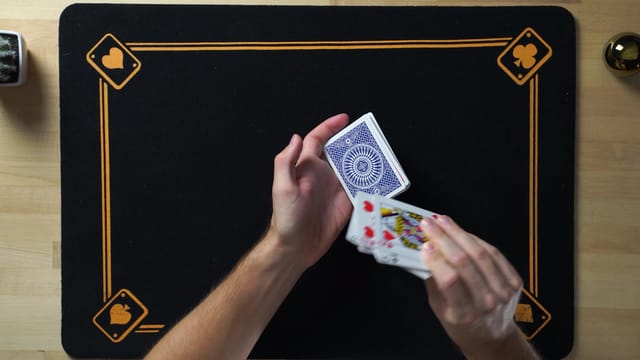
Overhand Shuffle Controls: Positions, Reception, and Continuity
Overhand shuffles can be used to change or preserve the position of a card without breaking the flow of the action. In this lesson, Julio Ribera brings together five related explanations that allow you to study different applications of the overhand shuffle.
The work begins with an overview of the controls and continues with videos dedicated to the bottom, the top, the second-from-bottom position, and receiving a card during the shuffle. The examples show how to connect these possibilities within a cohesive handling.
Preparing a reference when receiving the card
The first explanation connects the control with the way you offer the packet to the spectator and receive the card. Julio examines the cue that guides its return and the jog that allows you to recover a break afterward.
He also discusses how to distribute the cards and square them up again to integrate the reference seamlessly into the appearance of a shuffle. The learning process includes spectator management and the exact moment to continue shuffling, as well as finger action.
Bringing the card to the bottom and retaining it
A dedicated video explains how to transfer a card from the top to the bottom and keep it there while you continue shuffling. It covers stripping off a single card and the pressure that allows you to pick up other packets without dragging the card you want to preserve.
Julio reviews the difference between changing a position once and being able to continue shuffling while keeping that position under control. That retention is part of the technique you can later link with other handlings.
Recovering the card to the top
The next explanation builds upon the bottom control and develops the transition to the top. It covers the transition between taking packets and running cards one by one as you approach the finish.
The example is repeated with a face-up reference card to clearly follow its journey. The goal is to control the rhythm of the shuffle and recognize the exact moment the necessary action changes to complete the transfer.
Controlling the second-from-bottom position
Another explanation combines taking the top and bottom cards to keep the chosen card in the second position from the bottom. Julio shows how he coordinates the touches and how the rest of the deck is shuffled on top.
This is a useful position when you need the card not to show when displaying the end cards of the deck. The lesson explains how to secure it and, in the overview, how to continue shuffling while retaining the small bottom stock.
Receiving the card in the middle and setting another position
The most extensive explanation revisits receiving a card during the shuffle. It covers the cue given to the participant, the jog that acts as a reference, the recovery of the break, and the continuation of the movement until the card is controlled.
From there, the top control is linked to other destinations. Julio includes an example of placing the card at a specific numerical position—the fifth position in the explanatory demonstration—and maintaining that arrangement with the same family of movements.
The emphasis is on making the actions look connected: receiving, shuffling, squaring, and continuing. The reviews help you study this continuity and prevent the preparation from standing out as an isolated gesture.
Materials and prerequisites
You need a standard deck and familiarity with the basic overhand shuffle action. The videos develop control applications based on that foundation; they do not replace a complete fundamentals course nor do they teach every false shuffle or force mentioned as possibilities from start to finish.
The lesson is taught by Julio Ribera. It includes explanations and examples of various destinations, with repetitions that allow you to practice the reception, the reference, and the rhythm before putting the controls together.