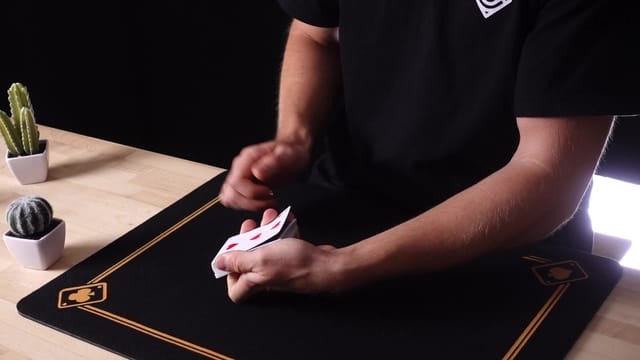
Regaining the Break
How to Get Your Break Back Without Looking
You’ve just performed a perfect double turnover. The card is face-up on the deck, and your friends are looking right at it. Now you need to turn it back over, but you’ve lost your pinky break. Nothing kills a trick faster than staring at the deck while you fumble to find your spot again.
This lesson teaches you how to get that break back invisibly. You'll be able to look your friends in the eye while you square the cards, knowing the break is already right where you need it.
Two Ways to Keep Your Double Lift Smooth
The teaching is split into two clear videos. First, you’ll learn a two-handed method that uses the "Biddle grip" to hide what’s happening. Then, you’ll learn a one-handed method that uses simple finger pressure to do the work for you. Both methods focus on making the move look like a natural way of squaring the deck.
What’s the Difficulty?
This is for magicians who already know the basics of a double lift. You don't need to be a pro, but you do need some "feel" for the cards. The hardest part is learning how much to let the cards overlap without it looking messy. You'll need about an hour of practice to get the mechanics down and a few days of playing with it to make it look smooth.
About Julio Ribera
Julio Ribera specializes in card magic that looks effortless. He has taught thousands of students how to move away from clunky moves and toward sleights that are actually invisible to an audience.
What's Included
- The "Behind the Deck" method for a secure recovery
- How to land the card with a slight "outjog" to create a gap
- The one-handed "Front Recovery" using index finger pressure
- How to use the Biddle grip to hide the pinky insertion
- Tips on making the gap smaller as you get more comfortable
- How to avoid the common mistake of "riffling" in front of spectators
Frequently Asked Questions
Do I need to know how to pinky count?
No. These methods are actually great alternatives if you find the pinky count too difficult or unreliable.
Which method should I learn first?
Method 1 (from the back) is usually easier to hide because your hand covers the back of the deck. Start there.
Does this work with any deck of cards?
Yes. As long as the cards aren't extremely sticky or old, these techniques work with any standard deck.
How do I know if the gap is too big?
If you can see the gap from across the room, it's too big. Julio shows you how to start with a large gap while learning and how to shrink it down until it's invisible.