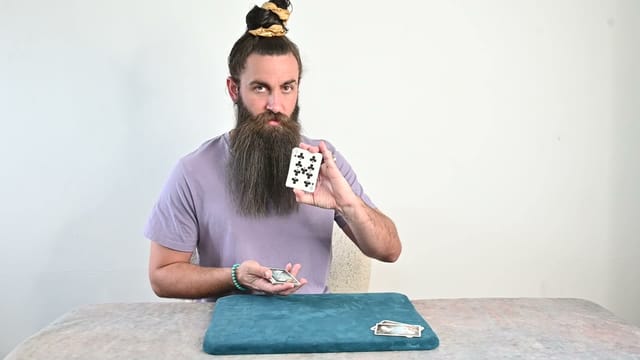
Soulmates: three card coincidences
Three increasingly impossible coincidences
A pair of cards matches at the point indicated by the spectator. It then happens again without the magician knowing in advance how many cards have been set aside. In the last phase, the participant thinks of a number and the coincidence occurs at that very position. Leandro Furtado presents the complete routine and explains how to prepare, perform and link its three stages.
The matching cards have the same rank and colour but different suits: for example, the queen of spades and the queen of clubs. They are not identical duplicates. The routine uses an ordinary 52-card deck, which you can continue to use afterwards, although it requires a specific arrangement before you begin.
Preparing the deck and locating the cut
The explanation begins by separating a group of cards and their matching partners. You are shown how to interleave one part with the remaining cards and bring the packets together in the required order. This setup makes the coincidences possible; it should not be confused with a deck freely shuffled immediately before the performance.
Leandro uses a small bend, or crimp, as a reference for locating the cut. He explains where to place it and mentions another way of preparing this reference. The aim is to separate the packets naturally, without always showing the same card or making the search the focus of attention.
You do not need to buy a special deck or add duplicate cards. You should, however, work with a complete deck, prepare the sequence carefully and become familiar with the cut before presenting it to an audience.
First phase: a known quantity
The spectator cuts off a small packet and counts the cards by spreading them in the hand. Leandro explains how to give this instruction so that the participant preserves their order. He also explains why the packet must be small: enough cards will be needed afterwards to form and count the other two groups.
In this first stage, the number is stated aloud. The magician deals the two packets in parallel, and the matching cards appear at the corresponding point. The demonstration shows the rhythm of the count and the moment to emphasise the coincidence.
Second phase: keeping the number secret
After the deck has been reassembled, the procedure is repeated, but the participant counts their packet without revealing the total. They can do this with their back turned or out of sight, always maintaining the order of the cards.
The spectator stops the magician one card before reaching their number. The next pair completes the revelation. The class clearly distinguishes between knowing the quantity from the start and discovering it at that moment: this change in conditions gives the repetition its purpose.
Third phase: a thought-of number
The last phase begins with a thought-of number from one to fifteen, different from the previous numbers. The participant takes that many cards from the top as a record of their choice, without telling the magician the number.
The handling preserves the structure of the count, but the presentation stresses that this time it involves a mental decision. Both the coincidence and the set-aside cards that confirm the chosen number are shown. The effect has these specific conditions; it is not offered as a coincidence at any position in an unprepared deck.
Resetting, presenting and giving the effect room to breathe
An essential part of the class is how to gather the cards and restore the situation between phases. It details the order of the packets, returning the spectator's group and placing the cards that have just matched. Changing this order can prevent the next coincidence.
Leandro recommends keeping the packets squared to avoid revealing matches too early, watching the angles when cutting and allowing the audience a few seconds to react. Finding the cutting point is incorporated into the idea of sensing a connection with the participant.
The presentation can explore connections, coincidences or another theme that suits your performance. The teacher explains how he uses the routine to lead into more emotionally charged moments in his shows. Practise the setup and each reset first, then add the instructions, pauses and your own way of presenting the three phases.