All-round card magic: six effects and building a routine
A complete performance, from technique to presentation
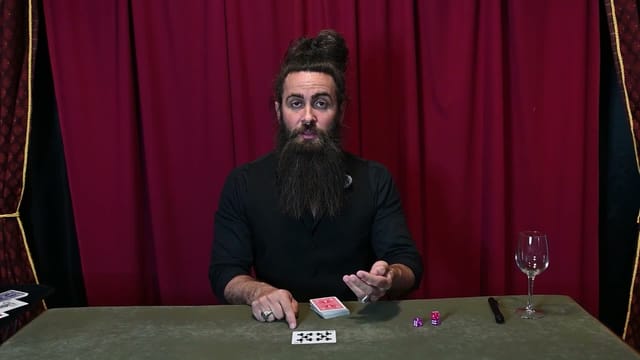
Leandro Furtado teaches you how to build a card-magic repertoire that you can structure and present in your own style. The masterclass combines a six-effect performance, explanations of the effects and extensive work on atmosphere, character and your relationship with the spectators. You will learn both the card handling and the decisions that allow you to link the tricks and give them meaning for an audience.
The Conexiones performance shows the result: cards that seem to travel through time, kings that pass through portals, aces found by intuition, selections caught between cards, a card located using dice and a finale with signed cards. Leandro then breaks down the preparation, methods and transitions. The three videos form a single class and should be studied in order; the sandwich explanation begins in the second and continues in the third.
Atmosphere, naturalness and character
The first part explores how to turn a succession of moves into an experience the audience can follow. You will work on consistency between open and secret actions, eye contact and directing attention, speech and silence, and the pauses that separate the method from the effect. Leandro also explains how to preserve the contrast between the starting situation and the outcome, without letting the patter run so long that the audience forgets what was supposed to happen.
Leandro suggests identifying your strengths and choosing a way of communicating that you can sustain. Your voice, gestures, humour, clothing and props should support your character. The examples invite you to consider how to adapt the same script to a theatre, wedding, bar or table: changing the pace and depth to suit the setting while retaining your own presentation. Music is discussed as an optional aid to dramatic construction.
Preparing the repertoire and preserving its links
A deck is arranged with a joker, aces and a stock of cards that will be used later. You will learn which positions to preserve, when to remove cards that have already played their part and how to use conversation or a spectator's inspection to restore a setup. The work includes choosing a reliable opener and a strong closer, as well as ways of combining the effects for different situations.
The transitions serve a practical purpose: the state of the cards at the end of one trick helps set up the next. It is therefore worth studying the complete sequence before changing its order. Some alternatives alter the setup and the cards you can show; the class identifies those conditions so that you can choose a consistent handling.
1. Time travel with a selected card and a joker
A card that appears to have been lost returns through a presentation about time. The explanation covers handling a double from the middle of the deck and a double lift from the top, obtaining breaks and retrieving a double card that is left slightly outjogged. The Stuart Gordon turnover is also shown as an option.
Beyond the move itself, the class examines the cover provided by the hand, looking at the spectator and the moment to let the final image settle. The aim of the presentation is for the audience to remember the journey through time and the relationship between the selection and the joker. The ending leaves the deck ready to continue the repertoire.
2. Portals with kings and blank cards
The kings travel in a packet sequence that uses blank cards as portals. Leandro presents this family of effect as a version of Jazz Aces with kings and explains the setup, loading and unloading cards, and the successive journeys.
This section develops the Elmsley count and handling a double with a small packet. You will learn to coordinate pressure, push-off and taking the cards, reduce unnecessary movements and maintain a consistent display. The same way of counting is retained even when there is nothing left to hide: this approach helps the technique blend into the presentation.
3. Cutting to the aces
The audience takes part in cuts and reassembling packets that end with the appearance of the aces. The explanation shows how a partial shuffle preserves the stock and how the packets are formed as the spectator tells you where to stop.
The instructions are part of the method: Leandro explains how to ask for the cuts to be completed so that the apparent freedom still preserves the necessary conditions. Care is also taken not to expose the card set aside for later tricks. The next transition retrieves the cards that need to remain in the routine.
4. Ace sandwich with three selections
Three selected cards are trapped by the aces after a sequence of vanishes. The class covers a multiple control, the swing cut, breaks and the double cut, as well as preparing the group of cards loaded when the aces are brought together.
The explanation continues with displays of the cards that apparently remain, attention to thickness and angles, and the final vanish. Two handlings are offered: their setups and the number of cards shown differ, so you must follow the conditions of the version you choose. The revelation is completed by bringing the packets together and spreading the deck while preserving the order of the selections.
5. Card at a number with three dice
A card's position is obtained by adding the hidden faces of three stacked dice. Leandro explains the property of opposite faces, the setup of twenty cards before the new selection and the use of a signed card as a reference.
The handling links to the preceding sandwich and incorporates packets shuffled by the spectators, a false cut and an adjustment using a count and a double cut. You will learn which part of the arrangement must be preserved and how to coordinate the secret work with rolling, stacking and adding up the dice. A discussion of chance and probability provides the presentation for the effect.
6. Signed-card transposition
The finale brings together a selection, a signature and the spectator's physical participation in an exchange of cards. Leandro explains how to retrieve the stock, set up the positions, perform the top change and link it to a double, folding the cards and the gesture that presents the transposition.
Attention is directed through a specific request to the participant and through eye contact. Leandro works on the spectator's position and cover in relation to the dominant hand, and shows a variation with an apparent selection from the middle. The smoothness of the change and the separation between actions require rehearsal so that the audience can clearly follow what happens.
Materials for practice
Prepare a poker-size deck with a joker and four aces, one duplicate card, four additional kings, four blank cards, three ordinary dice whose opposite faces add up to seven, and a marker. The class explains the signed-card reserve needed for the transitions. For the handlings shown, you will need a surface on which to place packets and stack the dice, as well as the cooperation of spectators during the presentation.
The teacher proposes a repertoire that can be performed without a close-up mat. The drinking glass he uses to hold materials, pockets and jacket are choices of organisation and character. The deck, its setups and rehearsing the transitions remain part of the work.
Prerequisites and how to study
Basic card-handling skills are helpful, along with a willingness to practise doubles, breaks, counts and changes. The repertoire combines accessible theory with phases that demand coordination, especially the vanishes and the top change. Discreet spreading offers alternatives to the pinky count; Leandro also discusses how to check a count when heat or the condition of the cards makes handling difficult.
Leandro is left-handed. Adapt references to hands and directions to the way you usually hold the deck, preserving the function of each action. Rehearse the techniques first, then the transitions, and finally the presentation with eye contact, pauses and instructions. The comments on audience reactions help you adjust the performance without expecting the same response every time.
Teacher and references
The masterclass is taught by Leandro Furtado. In the theoretical discussion he comments on ideas attributed to Arturo de Ascanio and on the work of Gabi Pareras, and uses examples from different performers to reflect on character. The Elmsley count, the Stuart Gordon option and the Jazz Aces family are named within their specific applications in this repertoire.