Card at a number with dice: from imagination to reality
A drawn card between imagination and reality
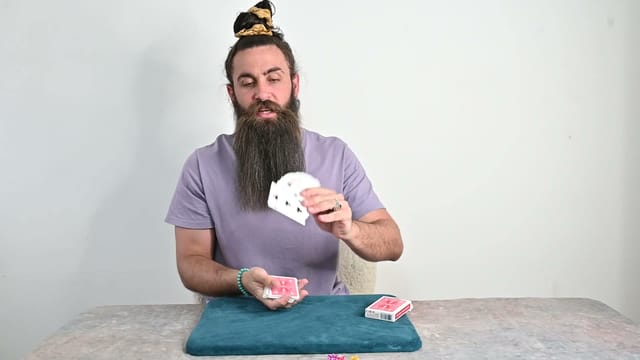
Leandro Furtado presents a card-at-a-number routine combining two decks and three dice. A spectator remembers a card, represents it on a blank card and loses it among the others. They then roll and stack the dice: the sum of the hidden faces indicates where their card appears. The ending adds a transformation: the cards that appeared blank are shown to be a printed deck, with one exception that connects to the initial selection.
The class includes a demonstration with a participant and an explanation of the method, setup and alternative handlings. Leandro uses the name ACAAN for this version, but it does not involve a freely named card and number: the selection is controlled and the position is obtained using the dice. The teaching allows you to study the effect under its actual conditions.
Preparing the two decks
You need two decks, blank cards with backs matching your chosen design, a marker and exactly three ordinary dice. You also need a surface on which to stack them and count the cards, and a plan for discreetly removing the packet that ceases to play a part during the routine.
Leandro demonstrates the first selection with a Mirage deck. It is an option for presenting the choice with apparent freedom, not a compulsory purchase: you can also use an ordinary deck if you have mastered a suitable force. The card shown initially must match the one later represented and the prepared ending.
The second deck requires an arrangement of blank cards, a discreet mark and a small reference crimp. The explanation details which card to locate, how to prepare the packet and why these references make the later actions easier. This is not presented as an impromptu routine with any borrowed deck.
Displaying, selecting and marking the card
You will learn to give the impression that all the cards are blank through a fan and other, simpler displays. Leandro is left-handed and explains an alternative for anyone who finds the direction of his fan awkward. What matters is preserving the appearance and the cards being shown while adapting the handling to your usual hand.
The class covers locating the marked card, holding a break and handing it over when the spectator calls stop. Two ways of handling this moment are offered, with attention to rhythm and preventing indices that should remain hidden from becoming visible.
While the participant draws or writes their card, their attention allows you to separate and remove the packet of blank cards. Leandro explains the palm, finger pressure and removal of the packet. This phase requires rehearsal: knowing the setup alone is not enough to perform it naturally.
Preserving the position and using the dice
The card returns to the deck, and the class works through a partly genuine shuffle that preserves the necessary position. The sequence combines packets and single cards; the teacher then checks the result by counting. It must not be replaced by a completely random shuffle.
He then explains the property of opposite dice faces and how to use it when the dice are stacked. The spectator adds up the five horizontal faces that are hidden. The examples in the class show how to relate this sum to the card's final position.
The adjustment is made using a pinky count and a double cut. If you have not yet mastered that count, there are alternatives for counting the cards while the spectator is busy adding. A distinction is made between performing for one person and performing with more onlookers, so that you can choose a handling suited to the situation.
Building your own presentation
The ending links locating the card to the appearance of a printed deck. The class explains the importance of the card missing from that deck and its relationship to what the spectator has drawn.
Leandro leaves the presentation open for you to develop your own story. Practise the display, force, palm, shuffle and cut separately, then link them with the instructions to the participant. The aim is for the preparation and technique to support a clear sequence, without the patter interrupting the actions or the addition of the dice.