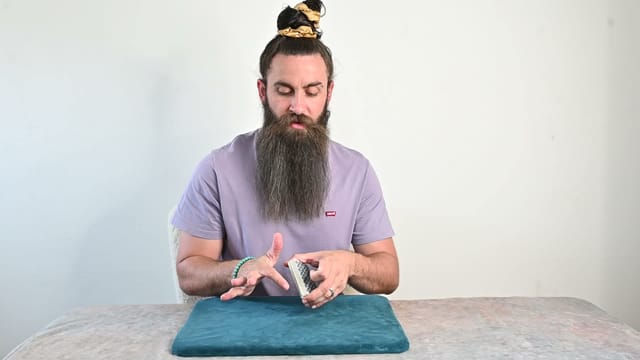
Express sandwich: two kings trap the selected card
Two assistants that find a card
A spectator chooses a card and loses it in the deck. The magician introduces two kings as his assistants: they appear, vanish and end up inside the deck, trapping the selection between them. Leandro Furtado demonstrates the effect with a participant and then explains the complete sequence.
The presentation uses the joke of having lost the card rather too thoroughly and needing help to retrieve it. The work combines a brief plot with visual moments and a final revelation. It can serve as a close-up piece within a longer performance, without relying on the audience knowing any other tricks.
Setup and control of the selection
You need an ordinary deck. The demonstration uses the two red kings as the featured cards, although other pairs are suggested, such as queens, aces or jacks. They are not two duplicates: the example cards share a rank and colour but have different suits.
The setup places one of these cards on top and the other on the bottom. Leandro discusses how to preserve both positions when shuffling, then moves on to controlling the selected card, which must end up third from the top. It is important to distinguish this position from a card simply returned to the middle of the deck.
The main handling combines a tilt-style insertion with a Charlier cut. Leandro explains how to hold the break, receive the selection and square the packets to maintain the appearance that the card is lost. If that coordination is still difficult, he offers alternatives using the conventional tilt and displaced cards, with the same control objective.
Obtaining the break without relying on the pinky count
The routine uses a break beneath two cards. Leandro shows how to obtain it with the pinky count and offers another option: pushing over two cards with the thumb and retaining the break as you square up while the spectator looks at their selection.
The alternative is explained again during the display of the kings. Mastering the pinky count is therefore not a prerequisite for studying the effect. You do need to learn to hold the break and display the packets naturally, without letting the adjustments interrupt the presentation.
Producing the kings and making them vanish
The production uses the cards at the two ends of the deck: as the deck moves towards the other hand, the two kings are retained and appear separated from the rest. The grip, pressure and gesture are explained in detail, with attention to the deck arriving properly squared. Practise this action on its own before linking it to the vanishes.
The first vanish handling uses several cards aligned as one and coordination between the packet and the king being shown. The explanation is repeated and then incorporated into the sequence of displaying the two assistants.
An Erdnase change is used for the second vanish. Leandro explains a more visual variation that coordinates the hand movement with the card's displacement, and a simpler alternative in which the change is covered by the hand. Both are presented as options for this phase, rather than as two complete additional effects.
The teacher points out that he is left-handed. His references to hands and directions reflect his own handling; if you work with the other hand, mirror the movements while preserving the function of each action. The explanation does not require everyone to throw in the same direction.
Bringing the packets together and revealing the sandwich
After the vanishes, the class examines how to spread and reassemble the deck while reversing the order of the packets. Looking at the spectator and a brief pause in directing attention accompany this action. The story explains that the kings have not become lost: they have gone to find the card.
The final spread shows a single card between them. Having the selection signed is mentioned as an option; you will only need a marker if you choose that presentation.
Rehearse the control, production and each vanish first, then their links with eye contact, patter and revelation. The class develops these handlings within a specific routine; ease with the grips, breaks and alignment of cards takes practice.