Musical magic for celebrations: floating table and colored ribbons
A musical act within the show
Borja Montón suggests a brief visual pause to change the rhythm of a show for weddings, baptisms, communions, or birthdays. He explains why a musical act can function as a transition after a spoken or participatory section, without stopping the show or turning it into an intermission for the audience.
The class combines practical advice on Losander's floating table, the explanation of a colored ribbons routine, and an overview of other repertoire possibilities. The proposals have varying levels of development: not all the tricks mentioned are taught as complete routines.
Floating table: handling and preparation
Borja shows two table models from his repertoire and discusses their differences in setup, transport, fragility, and use in celebrations. He explains how to check the parts, prepare the accessories, and avoid movements or noises that weaken the illusion. He also addresses what can happen when children approach the equipment and why it is best to choose the setup based on the space and the type of performance.
The main work consists of separating the body's movement from the table's movement. It studies when to keep the performer still, when to move without visually dragging the object, and how to prevent the table from seeming to follow every gesture. Adjustments and performance examples are shown, including the combination with soap bubbles.
This is an explanation of handling details based on his experience. It does not include the manufacture of a floating table or fully reveal its workings; working with that apparatus requires the material and instructions corresponding to your model.
Colored ribbons: construction and routine
This proposal is explained from preparation to finish. Three ribbons of different colors are placed into cones; two vanish and end up tied to the third. The action allows several children to participate by holding the items and following the journey of each color.
The explanation covers the construction of the cardboard cones, the preparation of the ribbons, and their arrangement before starting. It demonstrates step-by-step handling, how to display the items, which angles to protect, and how to coordinate the vanishes with the final revelation. Borja also discusses how to leave the tied ribbons in view so the result is clearly understood.
It can be presented with music and simple visual actions. Follow-ups with doves or a fountain of silks are linking ideas, not techniques developed here.
Other repertoire possibilities
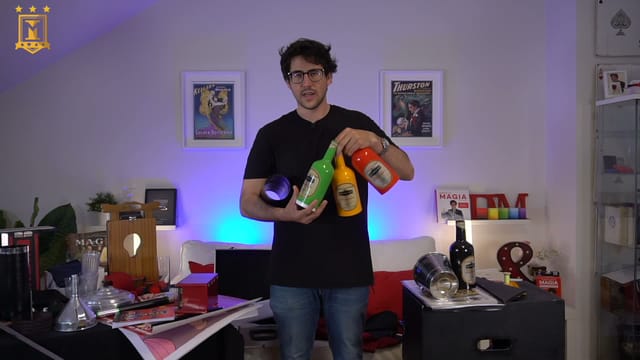
The multiplying bottles, the giant three-card monte, the Miser's Dream, and the torn and restored thread are discussed. Borja explains why they can fit into a musical moment and shows materials or handling fragments. These interventions serve to compare options; they do not replace a full explanation of those effects.
The conclusion suggests exploring a manipulation act with balls or with objects that suggest soap bubbles. It discusses giving meaning to the action for a children's audience, but a complete manipulation routine is not taught.
Materials and practice
For the ribbons, you need cardstock, colored ribbons, adhesive tape, glue, and a place to organize the material. The floating table requires its own apparatus and accessories. It is not necessary to acquire all the mentioned tricks to work on the ribbon proposal.
It is advisable to rehearse the sequence, the positions of the items, bodily coordination, and children's participation before incorporating it into the show. The class guides the choice of the act; it does not provide a fixed choreography or a musical track. Materials are not included, and the brands and prices mentioned belong to the time of recording.