Silk to Egg
A pseudo-explanation routine with a second kicker
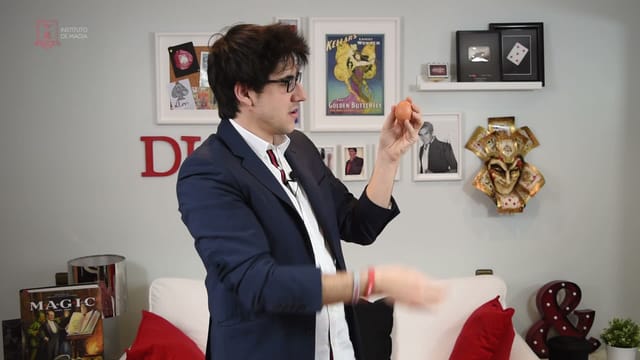
Borja Montón presents and explains Silk to Egg, a parlor and stage classic where the audience thinks they understand what is happening before encountering a fresh surprise. The class combines an initial performance, a study of handling and patter, a review of the complete sequence, and a gimmick-making workshop.
Building the surprise and engaging with the audience
We analyze why a seeming explanation can bring the magician closer to the spectators without exhausting the effect. You will learn to give time for the first transformation to register, invite the audience to participate, and maintain interest during the repetition that leads to the climax.
Borja works on group questions, pauses to listen to their responses, and alternatives when a reaction does not come immediately. He also discusses this routine's place within a show and its application to children's audiences. Humor is approached as part of the persona: examples are shown, but it is emphasized that you should adapt the presentation to your own performing personality.
Preparation and handling of the props
The explanation reviews the choice of the silk, the size of the gimmick, and the organization of the material before starting. Square and diamond silks are compared, and how volume influences handling is discussed. For the eggs, it is recommended to choose a comfortable size for the hand and aim for a consistent appearance in color and dimensions.
Technical work includes the way to gather the silk, apparent gestures, hand-to-hand transfers, and coordination with jacket actions. Alternatives are explained, and movements are repeated to show where it is best to hold the audience's attention and how to avoid telegraphing what is about to happen.
The second part of the routine is studied separately: what changes compared to the first presentation, how to maintain clarity while seemingly teaching the effect, and how to set up the final moment. The review links these phases so you can study both the isolated movements and their continuity.
Timing, visibility, and presentation details
The class pays attention to working distance, angles, and the time each visual moment needs to be understood. It also explains how to leverage audience expectation and how to respond within the presentation when someone thinks they have figured out the method.
Minor incidents that may arise during rehearsal, such as dropping the silk, are discussed, along with the advisability of staying calm and simplifying gestures. Adding flourishes or copying the teacher's humorous tone is not required; the goal is to build a sequence you can present naturally.
Optional crafting workshop
The final block teaches how to prepare a homemade gimmick using a real egg. It covers shell preparation, cleaning, drying, reinforcement, and finishing, showing details that require patience so as not to ruin the piece. The usefulness of having spares in different sizes and colors is also discussed.
This workshop is an alternative to store-bought gimmicks, not a prerequisite for learning the routine. Crafting takes extra time and uses cutting tools and hot glue. The recording explains safety and care during the process, including cooling down and checking the finish before using the piece.
Materials and recommended practice
For the routine, you need a small silk, a suitable Silk to Egg gimmick, a real egg for the climax, a glass or goblet, and a jacket with accessible pockets. Small auxiliary prep materials, such as paper or fabric matching the silk's color and adhesive, are also shown. During part of the explanation, a durable practice egg is used to prevent breakage; the performance climax uses a real egg.
If you choose to craft the gimmick, add an egg for shell work, masking tape, a precision hobby knife or small scissors, water, drying paper, and a hot glue gun with glue sticks. A hair dryer is mentioned as a drying alternative.
The necessary handling is developed in the class, but it requires rehearsing the transfers, material placement, and audience interactions using the costume you plan to wear. Additional silk productions and combinations with other effects are mentioned as possibilities; you do not need to incorporate them to practice the taught routine.