Dai Vernon's Cups and Balls Routine
A complete cups and balls routine
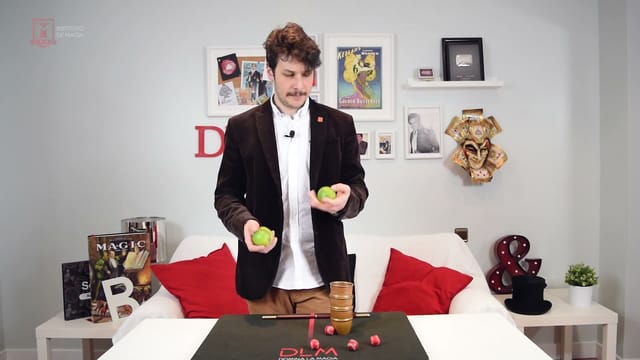
Ricardo Sánchez presents and explains his handling of Dai Vernon's routine as found in Stars of Magic. The sequence combines vanishes, travels, assemblies, and ball penetrations through the cups, spectator involvement, and a grand finale with larger loads.
The explanation examines each phase as an effect that must be understood on its own terms. The finale does not replace the need to clearly present what happens beforehand: you must allow time for each vanish to register, for the audience to recognize where the balls are, and to distinguish an assembly from a penetration.
Technical resources and alternatives
The class covers the false transfer with a finger palm and its coordination with the magic wand. Two visual vanishes are compared: David Williamson's strike vanish, which requires precise timing, and a simpler alternative using the wand. The handling differences are explained so you can choose the one that suits you best.
Ball additions and subtractions are also covered, along with transfers between hands and cups, and loading actions performed while picking up or setting down the props. The explanation occasionally uses transparent cups to reveal the paths of the objects during the study.
The final loads are broken down step-by-step from stealing them out of the pocket to setting the cup down over them. The instructor analyzes the relaxation of the fingers, wrist, shoulder, and body, the angles, and the relationship between the primary action for the audience and the covert movement that must remain in the background.
Structure, participation, and timing
After reviewing the technical resources, the routine is walked through phase by phase: presentation and examination of the props, initial vanishes, travels determined by the spectator's choice, the ball assembly, penetrations, and the final sequence. Starting options are compared, and the changing conditions when choosing one over the other are explained.
The concluding section uses a humorous fake explanation as part of the presentation. Its role within the script is examined, alongside how to coordinate the patter with the repetitions and surprises. This complete review allows you to follow the chaining of effects without losing sight of what the audience is supposed to perceive.
Materials and phase-by-phase study
You will need three opaque cups, four small balls, a wand, and three fruits or large objects that fit inside the cups, as well as a table and clothing with suitable pockets. To preserve the nesting phases, the cups must stack properly. The class discusses alternatives using everyday glasses and objects, noting that certain materials may require adapting the sequence.
It is helpful to be comfortable with false transfers and palms; specific techniques are explained in the video. The suggested working method is to master one phase before adding the next, without rushing toward the finale. It is also recommended to rehearse with music to study the internal rhythm and experiment with different speeds and presentation styles.