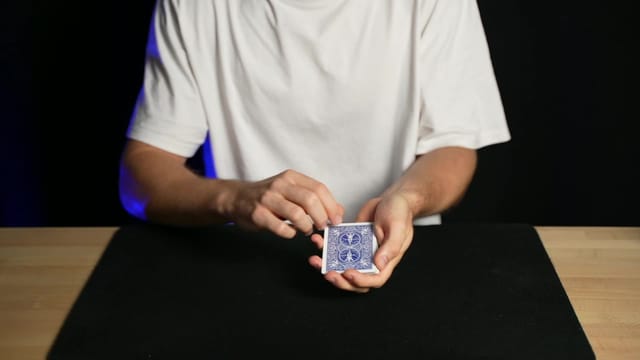
Bottom Deal: bottom deal, practice and visual applications
The Bottom Deal allows you to take a card from the bottom of the deck while the gesture appears to be a normal deal. Julio Ribera devotes an extensive explanation to separating its actions, coordinating them, and building a gradual practice routine. The technique serves as a resource for gambling demonstrations and for various card magic effects.
Grip and reference movement
The instruction develops a grip that Julio connects to Daniel Madison and compares with other possibilities from the Mechanic Grip. The most extended hand position, the corner hold, and the way to maintain a comfortable posture are studied.
Before the bottom deal, the exit and recovery of the top card are practiced. Julio insists on observing a genuine deal: the bringing together of the hands, the take, and their final separation will be the pattern to replicate when performing the technique.
Learning each action before putting them together
The explanation moves on to the movement that releases the bottom card and shows its path from various angles. Pressure, the necessary flexion, and the drag are distinguished, ensuring that the finger movement remains small.
Then both cards are combined. The work aims to make their paths compatible and to ensure the take happens while the hands are coming together. The squaring recovery is also explained so as not to leave a card jogging after dealing.
A progressive practice plan
Julio suggests studying the complete video and correcting the position before automating it. Practice begins with an isolated action, continues by releasing bottom cards with a full deck, and finishes by alternating normal and bottom deals.
Ways to visually check which cards come out and exercises with different sequences are shown: one normal and one bottom, or several normals before the bottom. The goal is to choose when to perform the technique while maintaining the same rhythm, rather than just repeating it blindly.
Angles and applications
Visibility from different sides and how the direction of the deal influences it are compared. Cover must be studied from the audience's actual viewpoint and according to each person's level of mastery.
The final part includes examples of ace dealing, a force, and a card to a chosen number. It also shows the take with a card flip and a visual back change as applications of the same principle. Eric Chien's routine is mentioned to illustrate possibilities; his full act is not taught here.
Materials and required foundation
You need a standard deck and fluency with a normal deal. Bee cards are mentioned as an aid for handling and camouflage, but the teacher states that it can also be done with a standard deck and uses another one so the movements stand out. Buying a specific brand is not mandatory.
The Bottom Deal is a difficult technique that requires a lot of practice. This lesson provides the breakdown, exercises, and brief applications to work on it thoughtfully; it does not promise an angle-proof execution or immediate learning.