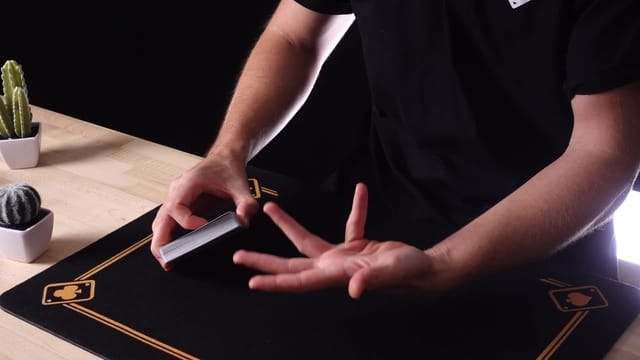
Card dribble: classic and modern versions
The dribble drops the cards from one hand to the other progressively. It can be used as a flourish and for a spectator to call stop and choose a card. Julio Ribera teaches two versions of the handling and explains why he prefers one of them when he needs more control over the release of the cards.
The classic version
The first explanation starts from Biddle Grip with additional support. Gentle pressure, the placement of the fingers near the edge, and their progressive withdrawal are studied so that the cards do not all come out at once. Julio reviews the relationship between the thumb that releases the cards and the fingers that accompany the movement.
Reception is also part of the work. Straddle Grip is used to contain the cards and square up the packet when closing, paying attention to the support that prevents them from sliding out of the hand.
The modern version
The second grip changes the contacts on the deck and the position of the index finger. Julio relates this change to a more controlled release of the cards and demonstrates again how pressure and finger extension are coordinated.
The overall appearance of both versions is similar; the difference studied lies in the security of the grip and the ability to release the cards more evenly. The lesson allows you to compare both before choosing which one to work on.
Choosing a card and scope
It shows how to stop the dribble so that the spectator can pick a card. A force demonstration also appears, but this tutorial should not be understood as a complete teaching of that force.
You need an ordinary deck and it is helpful to know Biddle Grip and Straddle Grip. Practice focuses on controlled pressure, evenness of the drop, and reception; it requires no prepared cards or gimmicks.