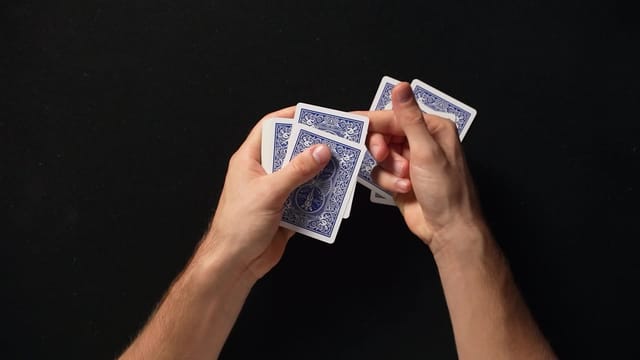
Second Deal: Second Deal and Gesture Continuity
The Second Deal allows you to deal the second card while the top card stays in place. Julio Ribera demonstrates its usefulness for forces, card to a chosen number, and dealing demonstrations, before breaking down the mechanics of the sleight. The examples establish its potential; the core of the lesson is learning a deal that maintains the exact same appearance as a normal deal.
Study the genuine deal first
The explanation starts from Dealers Grip and a pivot point that allows the card to emerge and return to a squared deck. Before introducing the substitution, Julio studies the real movement: how the hands approach, how the card is taken, and how they separate at the end.
That pattern serves as a reference for practice. The trajectory and rhythm must look identical whether dealing a normal card or performing the Second Deal. The tutorial explains why leaving a card jogging outwards at the finish breaks that continuity.
Push-out, take, and recovery
The technique is broken down into the initial displacement, taking the card, and recovering the top card. Julio reviews the timing for coordinating each action and the way to square the deck during the deal, paying attention to the cover provided by the wide movement of the hands.
Next, he shows a modified grip attributed to Daniel Madison and compares it to the initial position. The more extended hand placement is explained, along with its relation to other dealing techniques. The Bottom Deal is brought up for comparison; this lesson teaches the Second Deal.
Angles and study
The final part addresses the angle from which the audience observes the push-out and the position of the hand taking the card. Julio shows how visibility changes when varying the angle and how to integrate cover without interrupting the gesture.
For studying, he suggests practicing deals with a full deck and recording yourself to spot differences. You need an ordinary deck: Bee cards are recommended for their borderless design and handling characteristics, but it is explicitly explained that it can be done with Bicycle cards, which are used for the instruction. There is no mandatory purchase of a specific brand.
You should be comfortable with Dealers Grip and a normal deal. This is a technique that requires continued practice to match the gestures, not an automatic routine or a complete explanation of the tricks mentioned as applications.