Black Card in Card Magic: Cover, Construction, and Routines
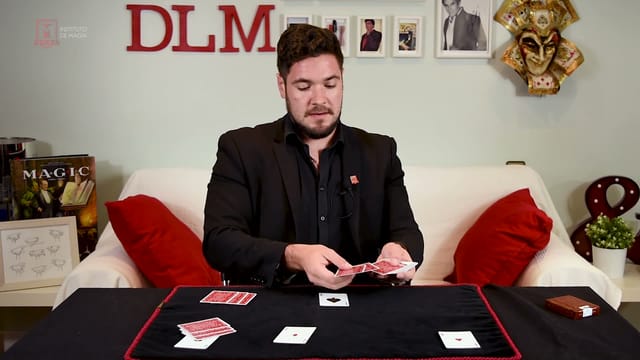
The black card is the centerpiece of this lecture by Luis Olmedo on black art applied to card magic. Through three routines, he explains how to integrate this resource into a comprehensible sequence, maintain proper viewing conditions, and prevent an appearance or vanishing from easily giving away the method. He combines material explanations, technique, sequence reviews, and an analysis of what the spectator perceives. The goal is to understand the possibilities of the tool and the decisions each performance situation demands.
Material Preparation
The first block examines the manufacturing of cards with a black face or a black back, depending on the application. Olmedo compares fabrics, velvets, and adhesive options, explaining how thickness, texture, glue residue, and edge finishing affect the result. He also highlights problems that can be caused by overly wet ink or small light patches left after trimming. Preparation is part of the teaching: owning a specific commercial trick deck is not assumed.
To practice this section, you will need expendable cards, fine black fabric, spray adhesive if the fabric is non-adhesive, a black permanent marker, and scissors or a craft knife. The instructor mentions adhesive velvet as an alternative. A protected cutting surface is necessary, along with a black close-up mat suitable for table applications. The relationship between the fabric and the mat is studied, without presenting a mere color match as a sufficient guarantee for performing in any environment.
Live Audience and Projected Magic
The lecture differentiates between two working conditions. When the audience looks directly at the table, Olmedo advocates for physical covers and a construction that keeps the gimmick protected. He analyzes objects, hands, and shadows as elements of that cover, as well as the uncertainty of working under lighting the performer does not always control.
When spectators watch the performance through a screen, framing, lighting, and the camera allow for different choices. He examines what changes when the entire audience shares a single viewpoint, and what happens in a mixed setting where some people can also look directly at the table. The instructor insists on rehearsing under real conditions and checking the image received by the audience. The technical capability to conceal an object does not replace the work of constructing the effect.
Card in Glass
The first routine starts with a chosen card and its appearance inside a glass. He explains the preparation, a ripple force, the handling of the silk and the glass, and the coordination of the movements that produce the revelation. The analysis includes body posture, dark wardrobe, the tilt of the container, and the timing of moving it away to reinforce the final impression. Olmedo places this routine particularly in parlor conditions, where he can better control audience visibility.
The materials needed are a deck, the corresponding prepared card and its normal equivalent, a crystal glass, and a sufficiently large silk. The instructor prefers silk for its drape and partial transparency. Distance and angles are specific conditions of this routine: the effect is not presented as suitable for any seating arrangement around the performer.
He also develops an encore with two chosen cards, a second revelation with different visual conditions, and options for getting rid of the prepared material. He discusses a variant contributed by Sergio Cisneros and the evolution of the presentation stemming from a conversation with Miguel Ajo. These examples serve to study how the second phase can reinforce the memory of the first, and how to suggest a condition of emptiness through natural actions without verbally insisting on proving it.
Open Travelers and Phase Variety
The second routine is a version of Open Travelers featuring four queens that travel successively to another spot on the close-up mat. After the demonstration, the techniques are broken down and the complete sequence is reviewed. The explanation covers lap loads, palms, Ascanio's Spread, double lift handling, additions, fake take actions, and hand-to-hand coordination. Some combinations require specific rehearsal; the instructor dwells on supports, pressure, rhythm, and continuity to facilitate study.
Here, the black card plays multiple roles within a single routine. The analysis distinguishes its function in appearances, vanishings, intermediate images, and the handling of an additional card. To practice, you will need four cards of the same value—the queens in the presentation—one card with a black face and a visible back, a black close-up mat, and a seated posture that allows you to use the lap during the explained sequence.
The routine also supports a study of multi-phase magic. Olmedo proposes varying both the method and the visible experience: surprise, anticipation, travel, and vanishing do not have to feel identical even if they belong to the same effect. He examines travel distance, pauses, gaze, gestures, and body orientation. He pays special attention to the final vanish, the spectator's mental framing, and the separation between the action causing the change and the moment it is perceived.
Ace Assembly for Camera and Screen
The third block explains an ace assembly designed for projected magic, presented by the instructor as a musical routine. Its setup includes a deck, normal aces, and prepared cards, including three black-faced cards and a piece made of three joined cards. Optional duplicates and the preliminary layout of the materials are discussed. Fabrication builds upon the finishing criteria already developed in the lecture.
The explanation covers false cuts, break handling, counts, packet switches, and several options for the vanishings. The continuous review ties these techniques to the sensation of having seen the faces and backs of the cards. He also analyzes how to simplify subsequent work through adjustments made during lower-tension moments.
This version requires the audience to watch the screen and the performer to control the angle, lighting, and camera. Olmedo explains why he uses an overhead shot and how certain turns can reveal edges that are best kept out of view. He also studies the composition of the mat, the removal of objects that generate visual clutter, and the final image that makes the travel of the aces recognizable. The routine is not offered as a version for spectators watching the close-up table directly.
Previous Preparation and Scope
It is advisable to have basic fluency with cards, breaks, double lifts, and two-hand coordination. The applied techniques are explained and reviewed, but Open Travelers requires working on palms, simultaneity, and attention control more deeply than the Card in Glass routine. It is not necessary to execute every combination to study the criteria of cover and construction.
The lecture teaches three concrete applications and criteria for experimenting with your own ideas. Mentions of coins, other resources, authors, and social media serve as comparisons or references; they do not constitute additional explanations of those repertoires or attached materials. Practice must be adapted to each routine, from wardrobe and glass angles to table setup and camera tests for the ace assembly.