Card magic: thought-of cards, naturalness, and torn and restored card
This lecture brings together five card magic routines and a practical analysis of their construction. The performances lead into explanations of handling, setup, and presentation choices. The common thread is the spectator's experience: what they believe they chose, what they remember, and at what moment they expect something to happen.
The material covers chosen and thought-of cards, two approaches to a torn and restored card to a number, and a progressive card elimination. The difficulty varies across versions; some rely more on structure, while others require technical control of cards and fragments.
Naturalness and effect construction
Dani suggests designing actions based on what the audience sees, rather than trying to fit a presentation to a technique afterward. He examines hand placement, why the deck is held or handed out, and how a gesture can retain its everyday appearance while serving a functional purpose within the method.
An example of a card turning face up in another packet is used to compare two ways of building a sequence. The analysis covers how to motivate the position of objects, integrate one action into another, and avoid movements that exist solely to solve a technical requirement.
The lecture explores the use of gaze, bodily tension and relaxation, questions, and pauses. Dani structures part of his analysis using rational, sensory, and emotional memories as a personal model for thinking about presentation. He also explains how to set up an expectation and deliver a clear payoff.
The Earthquake
Two spectators take part using one chosen card and one thought-of card. A presentation about vibrations and apparent misunderstandings leads to the location of both. The lecture covers deck setup, selection conditions, the return of the card, and the handling and count sequence.
The technical study includes break, pass, and card extraction, along with coordination with the audience's actions. It demonstrates how to separate the moment a card is returned from the moment a sleight is executed, and how to give gestures a visible justification.
The count is not treated merely as a mathematical operation; it is woven into the dialogue and the rhythm of the scene. The text discusses the differences between high and low values, instructions that prevent the spectator from getting ahead of the magic, and adapting the timing of the patter to what is happening.
The climax provides an opportunity to study the contrast between a chosen card and a thought-of card. Dani works on the pause before the reveal, the silence, and the performer's reaction. He also explains how he maintains recognizable roles for different participants within a session and recommends mastering the handling first before incorporating the full psychological construction.
The Extension of Memory
One spectator thinks of a card while another physically chooses one. Following an apparent memorization, the two exchange their cards within a spread, and the deck is shuffled again prior to the reveal.
The lecture covers the use of a key card, peeks, placement, and brief memory applied to the effect. It examines how to obtain information without interrupting the dialogue, the timing left between actions, and the way to remember what is necessary without overloading the execution.
This routine can be performed with a borrowed deck. Dani discusses what to say if a card is missing, if the choices match, or if a card ends up poorly visible after being moved. The response to these situations is integrated into the premise and natural actions.
The subsequent Q&A addresses searching for outs when something goes awry. The goal is to maintain an effect consistent with what has already been presented, rather than resolving any incident with a finale unrelated to the premise.
Torn and Restored Card to a Number
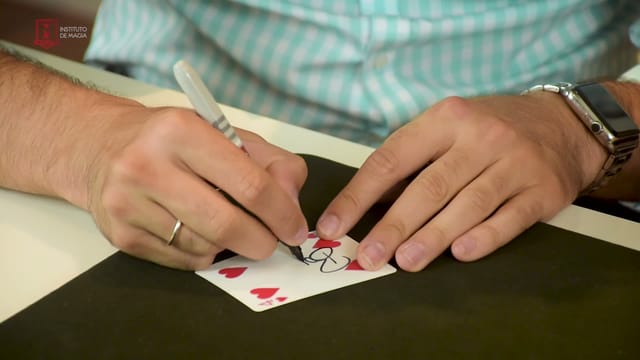
Two versions with different conditions and difficulties are presented. In the first, a signed card is torn, retaining a corner as a receipt; the card reappears at the indicated position, and the fragment matches. The subsequent explanation covers the work on the double tear, holding, transfers, and handling that supports this version.
The second, presented as Back at the Time, uses an unsigned card and the premise of going back in time. It teaches the corresponding setup, management of the number, audience participation from multiple spectators, and the coordination between attention and handling. Its structure is simpler than the signed version, though it requires material preparation and rehearsing the actions.
This section reviews how to gather and handle the fragments and different ways to resolve their vanishing. Solutions involving lapping, pockets, and objects already part of the scene are demonstrated. The sharpener/marker, card case, and other props are evaluated depending on the chosen version.
Card Identity and Construction Variants
The torn and restored card also serves to examine the value of a signature and a recognizable fragment. Dani compares constructions with and without duplicates and shares ideas on working with the apparent identity of a card and the visual features the spectator recognizes.
The double tear is explained with a focus on holding points, alignment, and material transfer. The handling of the retained corner and how to integrate it into the card to a number are reviewed. These are technical and construction resources that require practicing with cards that can be torn.
Certain proposals appear as brief examples: a card to a number illustrates working with signatures, and Matrix Restored demonstrates a potential application for the fragments. La Única and other works are mentioned as references; the full discussion focuses on the procedures and versions explained in the lecture.
Triple Intuition 2
The final routine progressively eliminates cards and packets until a single last card matches a spectator's choice. The setup using duplicates, collecting and shuffling the packets, dealing them, and the sleights that allow moving from one phase to the next are explained.
Audience management is part of the study. The analysis covers distributing instructions among participants, shifting attention, and clearly phrasing when a card is eliminated versus when it is chosen for play. The presentation builds the sensation of a thought-of card and sustains the expectation announced at the beginning.
The finale receives a specific analysis: who performs the final action changes, and the presentation of the choice is examined. The routine requires at least three spectators; Dani also describes his usual distribution with four.
Materials and Practice
You will need a deck, a table or surface for spreading and dealing cards, and a marker for the signed versions. The Earthquake uses a specific setup; Back at the Time and Triple Intuition 2 require their respective duplicate cards. For practicing the double tear, it is advisable to have spare cards on hand. The Extension of Memory and the described signed version allow you to work without a duplicate deck.
It is helpful to be comfortable with breaks, passes, double lifts, and palms. The lecture details their applications and several specialized handlings, but performing the routine as a whole also requires practicing rhythm, angles, and instructions. Lapping or pocket options must be rehearsed under your actual working conditions.