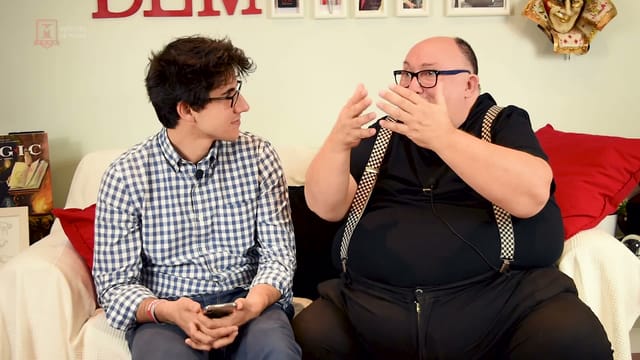
Children's Magic and Clown: Humor and Audience Participation
This lecture explores how to apply clown techniques to children's magic and how to build a rapport with both the children and the accompanying adults. Kayto combines acting exercises, stage examples, and a discussion on how to treat and direct your helpers. The core teaching focuses on developing funny situations and making audience participation an integral part of the show.
Laughter, the Body, and Preparation for Entrance
Kayto uses laughter as a character introduction: from the very first minutes, he communicates the exact relationship he wants to establish with the audience. He explains how he has worked on his own laughter and proposes an exercise starting from repeating syllables at different speeds. He demonstrates explosive, restrained, silly, and conspiratorial laughs, discussing the precise moments in which he uses each one.
The work involves observing one's own body and matching the voice with movements that fit it naturally. The proposal is to recognize each performer's individual capabilities and find a personal expression of humor. Stage conviction, attitude toward the audience, and physical posture are all linked to how humor is effectively communicated.
He also demonstrates breathing and vocal warm-up exercises that he uses before going on stage. Participants practice abdominal movement awareness and a calm sequence of inhalation, arm movement, and exhalation. He presents these as part of his stage preparation to project his voice and get into character.
The Clown, the Augusto, and the Construction of a Parody
The lecture examines the contrast between the serious character who sets the rules and the character who interprets them differently. Kayto describes the roles of the clown and the augusto and how the conflict between the two can sustain a scene.
The door parody serves to analyze a complete example: a simple instruction leads to misunderstandings, misdirections, and repetitions before the punchline. Oral parodies are distinguished from physical ones, discussing how to transform their development into a magical situation. The focus remains as much on the journey as on the final effect.
The performance of The Unfished Card illustrates this way of thinking using cards and rope. The analysis covers the expectations created by the title, the character's conflict, and the decision to change the usual outcome. Kayto notes that he usually performs this for adults and that, with children, he often prefers more direct effects that do not depend on remembering a card. This example develops the comedic structure rather than serving as a full technical card magic explanation.
Repetition, Apparent Failure, and Attention
Repetition is explored using words, tone shifts, and physical actions. He explains how to vary the delivery of a repeated question or gesture so that the situation keeps moving forward. The pleasure of anticipating something familiar and seeing it happen is also examined, much like the recurring running gags in a show.
Kayto compares the magician's apparent failure with that of the clown. A demonstration with a change bag and a silk handkerchief shows how a comedic difficulty can focus attention while accompanying a magic action. The analysis focuses on performance, timing, and the use of conflict. Furthermore, he discusses the possibilities of a squeaker, oversized props, costumes, and the scatterbrained character.
Choosing, Directing, and Acknowledging Helpers
A large part of the lecture deals with observing children before deciding what to ask of them. Attention is paid to their willingness to participate, their approach, and their energy level, allowing you to tailor the interaction to each specific helper.
He explains how to split the roles of the clown and the augusto between the magician and the participant, and how to give clear instructions that put them at ease. If using a sound system, Kayto mentions using the mute function to speak briefly with the helper before an action. He also covers positive reinforcement and progressing from simple cues to more elaborate participation.
The concept of creating heroes involves acknowledging the child's contribution and sending them off with a positive experience. The discussion includes shyness, spontaneous responses, and situations where adapting the plan is necessary. He emphasizes not taking the participant's physical abilities for granted or forcing a gesture just for the sake of the trick's convenience.
Difficult participation scenarios are also addressed, along with the importance of maintaining a kind demeanor. The examples rely on Kayto's stage resources: the job is to listen to what is happening and adjust the routine on the fly, rather than expecting everyone to react the exact same way.
Age, Energy, and Rapport with the Whole Family
The size of the space, the distance to the audience, and the age group are linked to the intensity of the entrance, voice, and movement. For younger children, clarity of the trick and repetition are highlighted; with older kids, the goal is to acknowledge their autonomy, give them a real role, and speak to them naturally.
The lecture also explores the presence of adults and how to involve them. A moment of collective complicity demonstrates how the relationship among spectators can be turned into prime comedy material.
The closing segment addresses what happens after the final trick: maintaining a consistent demeanor during the farewell, handling requests depending on the situation, and listening to what moments the audience remembers. This exchange is used as feedback to continue refining the show.
Props and Prior Knowledge
The laughter, body awareness, and vocal preparation exercises can be practiced without any magic props. The stage examples use cards and rope, a change bag, and a silk handkerchief; balloons, a squeaker, and contrasting-sized objects are also discussed. A microphone with a mute switch is recommended for situations involving a sound system.
To apply these ideas, it is helpful to have a familiar routine and rehearse it from the perspective of presentation and participation. No advanced manipulative sleight of hand is required. The handkerchief in the shoe and the bag and egg appear as repertoire references; their full methods are not taught in this lecture. The cited parody books are recommendations, not included materials.