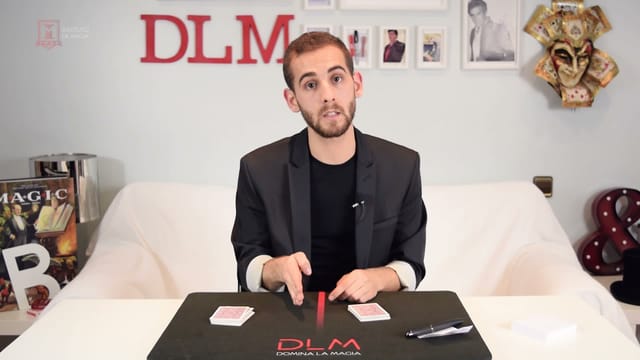
Card magic: Joker sandwich, prediction, and all backs
This lecture combines three complete routines with a study of their construction and the sleights they use. Víctor Piña analyzes why he places each object in a specific spot, chooses a participant, or performs a move at a particular moment. The explanation connects handling decisions with what the spectator must understand and experience.
The repertoire includes a three-phase Joker sandwich, a participatory prediction called Predestined Fate, and an all-backs routine featuring the aces. The study of double cards has its own dedicated block and is subsequently applied in the final routine. The content ranges from an accessible mathematical handling structure to technical sequences requiring advanced practice.
Building from the effect, the character, or the prop
Víctor distinguishes three starting points for creation: the feeling you want to produce, the performer's personality, and the properties of the material. He examines how each approach opens different possibilities and how to transfer an idea from one object to another without being limited to that prop's usual repertoire.
The analysis of the sandwich develops the economy of motion and means. The goal is for one action to set up the next moment, for the props to have a clear function, and for there to be no need to reposition cards without reason. Technical solutions are also compared to adapt to working angles.
The formal unity of the handling, actions in transit, and the differences between moments of attention and relaxation are explored. The explanation shows how a question, a revelation, or a participant's movement can provide cover and continuity to a sequence.
The magic gesture receives specific study. Víctor proposes that it should represent what is happening in the fiction, rather than using an identical gesture for different effects. The journey, the search, or the change in perception are made comprehensible through the body, words, and the rhythm of the presentation.
Three-phase Joker sandwich
Two Jokers have the mission of finding a chosen card. The routine progresses from a catch in the deck to an appearance between the Jokers at a distance and a final search inside the pack. Each phase modifies the conditions so the effect advances.
Preparation and card control are explained using two alternatives: the bluff pass and the Tilt, the latter with a detail attributed to Daryl. The riffle, breaks, and the choice of a control based on angles are analyzed. The study includes how to integrate the return of the card and continue the action without pausing at the technical moment.
The Cornelius appearance is briefly described within the first phase. The study covers the pause before revealing the card, the time needed to assimilate what has happened, and how to use the subsequent relaxation to link into the next phase.
The handling incorporates Ascanio's Spread, double cards, the Tenkai step, and the nail twist. It reviews how to make the most of the card layout and change grips without adding unnecessary movements. The explanation ties each sleight to the clarity of the sandwich and the conditions of the following phase.
The ending includes lapping from the edge of the table. Its coordination with the vanishes and the shift in body posture are explained so the climax maintains continuity. This solution requires rehearsing while seated and with a suitable table.
Audience participation and Predestined Fate
Before the second routine, Víctor addresses the relationship with assistants. He suggests asking and listening, learning something about the person, and using their answers to create moments unique to that performance. He draws a line between involving the audience and treating them as a tool or the butt of a joke.
In Predestined Fate, the conditions of an outcome between two groups of cards are written down in advance. Participants shuffle, choose colors, and exchange cards; when the final outcome is counted, it matches the prediction.
The explanation develops the mathematical principle of complementary packets using a scaled-down example and then with the full deck. The necessary conditions of the set, the calculation the magician must make, and how to obtain the information while the presentation continues are detailed.
The study examines which decisions can be modified, at what point they are locked in, and how to phrase the instructions. The script analysis includes the use of past and present tenses, recapitalizations, and the amount of information the participant receives. The precision of the language is part of how the routine works.
The parlor version uses two teams with their own names and spokespersons. It explains how to distribute the actions, keep the conversation going between the groups, and put them in the spotlight. This format allows alternating between a trick with heavy magician intervention and one where the spectators perform a good portion of the actions.
Double cards with and without support
The technical block begins with supported rollovers. The hinge, pressure, and leveraging the weight of the cards are analyzed to avoid rigid handling. Variations are shown depending on the height of the support and how the double is brought to it.
For unsupported handling, the three-finger pinch is developed and its role in the stability of the double card. Stuart Gordon's turnover is explained in detail: grip, curvature, thumb displacement, contact points, and transfer to the fingertips.
The move is repeated from different angles, and causes of mis-alignment are pointed out. The goal of practice is to use the necessary force, maintain supports, and avoid visible adjustments. The nail twist and Tenkai step were applied in the sandwich; this study expands on the stability principles shared by those handlings.
All backs with the aces
The final routine uses a premise about symbol recognition. The aces seem to lose their faces and show backs on both sides, including a card in the spectator's hands. Afterward, they recover their appearance, with the participant's revelation as the closer.
Preparation, the use of a double-backer, and the complete sequence are explained. Víctor analyzes why this resource brings clarity and how to combine it with technique without adding unnecessary material. The presentation on perception and memory functions as theatrical fiction.
The study includes Ascanio's spreads, brief reviews of the Elmsley count and the Frustration Count, handling double and triple groups, and their application to various displays. The orientation of the cards, curvature and contact between them, deposits on top of other cards, and the concept of the king's bed are reviewed.
The explanation also develops Marlo's KM move, the ring finger grip, the contagion move, and an indirect turnover. It shows how one exit facilitates the next technique and how to integrate changes into actions like pointing, approaching the spectator, or handing out a card.
The corroboration phases serve a purpose: to confirm the effect without turning the displays into a mechanical count. The spatial distribution of the cards, focus shifts, pauses, and the coordination between script and sleight of hand are studied. The finale reviews the entire routine in continuity.
Materials and practice preparation
A 52-card deck and a surface for spreads and packets are needed. The sandwich requires three identical Jokers compatible with the deck. For Predestined Fate, a stand to write the prediction on and a marker are used. The all-backs routine needs the four aces and a double-backed card of the same design.
It is helpful to be fluent with breaks, the riffle, packet handling, and double cards. Controls, rollovers, and counts are explained with varying depth: Stuart Gordon receives a detailed study, while some counts are reviewed just to apply them to the routine. To perform the set, you must also rehearse the instructions, the script, and the relationship between attention, movement, and revelation.