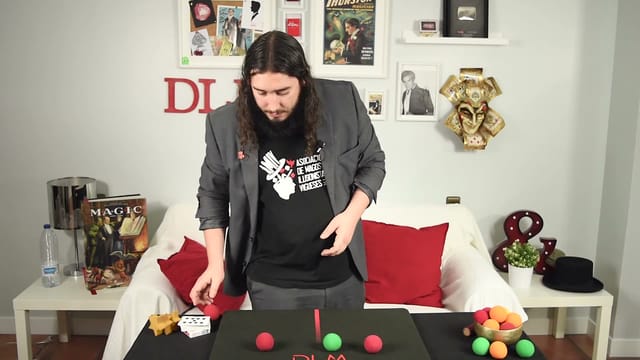
Sponges: Always Three, Ghost Balls, and Color Transposition
Building a Sponge Routine
The lecture explores how to develop a sponge routine that progresses clearly and highlights the effect happening right in the spectator's hands. Xulio Merino combines full performances, handling explanations, and structural analysis. A brief review of classic props introduces his approach to expanding available resources and evaluating what each phase contributes.
The work focuses on three sequences: Xulian Simplicity, a version of Always Three; My Ghost Balls, a routine connecting productions, travels, and transformations; and a color transposition. Sleights are taught in the context of the routines, providing options of varying difficulty so performers can tailor rehearsal to their skill level.
Xulian Simplicity: Always Three in Phases
The effect consists of pocketing one ball and showing three again, leading to a final vanish. The explanation analyzes how to vary the conditions of a repetition so each phase adds information: clarity of actions, clean displays, and understanding of what remains on the table.
Finger palm, compressing and releasing sponges, additions, transfers, and natural deposition are all studied. Attention is given to angles that need care and how to orient the body toward a spectator at a specific moment.
The finale features a two-beat false transfer and an alternative based on Vernon's false transfer. A direct sequence is also contrasted with a more technical one used by the instructor out of personal preference. Practice allows you to choose a viable path and work on gesture, gaze, and timing alongside the hands.
My Ghost Balls: Progression Toward the Spectator
The routine begins with a sponge appearing alongside a selected card. Additional balls are then introduced, linking an Always Three and a pass-pass sequence. The travels reach the audience's hands, and the sequence culminates in the production of sponge stars followed by their vanish.
The setup and organization of props, introduction from the deck, and handlings for transitioning between phases are explained. A direct entry with sponges is also provided for those who prefer to start without cards. A differently colored ball helps distinguish the elements and track the travels.
The technical section covers false transfers, displays, compression of multiple pieces, and the switch between balls and stars. Hand positions, angles, and simpler alternatives for certain displays and links are discussed.
The structural analysis develops a progression of exposure, increased clarity, and effect in the participant's hands. Some phases are delayed and revisited to keep the sequence growing. You will learn how to build an expectation, return to it, and ensure the climax connects with what happened earlier.
Handling the participant is part of the routine: giving clear instructions, allowing them to initiate the gesture of taking the balls, avoiding a tug-of-war, and letting them open their hand to discover the result. Pauses to savor a reveal and the use of a brief gag to regain attention before the finale are explored. The gag is presented as a pacing tool you can adapt to your style.
Color Transposition
The third sequence uses two-colored balls to present position exchanges and transformations, ending with a climax in the spectator's hand. A clear relationship is established between colors and table areas so the audience can easily follow the actions.
A change inspired by the Bobo Switch, adapted for sponge behavior, is explained alongside transfers, displays, and ways to set down balls. Simpler alternatives for false takes and changes are offered, as well as the instructor's personal handlings.
The analysis distinguishes between visual changes, which are seen as they happen, and changes the instructor calls dramatic, where the result is revealed after a pause. Contrast, attention, and combining both approaches to build an understandable transformation are studied.
The final phase focuses on handing the balls directly, instructions for the participant to extract one, and the connection between the visible transformation and the discovery in their hand. To practice, it is recommended to gain confidence with your handling before performing for spectators. Possibilities for linking the sequence with an Always Three are also discussed.
Props and Practice
Prepare standard sponge balls, including a set of matching balls and another set of two contrasting colors, three sponge stars, and a table or close-up mat with clear space. For the introduction of My Ghost Balls, a deck with its case is used; the direct entry allows you to practice the sponge work independently. Pocket organization and accessibility are covered as part of the preparation.
It helps to know the basic false transfer and the concept of finger palm. The necessary details for each sequence are explained, but compressing multiple sponges, displays, and switches require practice. The Bobo Switch serves as a reference for the third routine, and its application to sponges is detailed during the explanation.
First, rehearse a handling you can execute comfortably and add more demanding details as you master them. Review the clarity of each phase, hand orientation, and instructions with another person. Concepts of variety, contrast, and progression will also enable you to build your own sequences using these mastered resources.