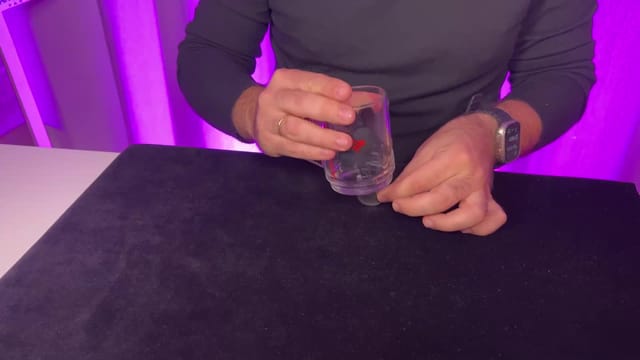
Coin through glass
A coin penetration through the bottom of a glass
The audience sees a coin next to a glass and, after a few taps, the coin appears inside it. José Arcario demonstrates and explains this classic, attributing it in the lesson to Joaquín Navajas.
The explanation covers the preparation of the props, the handling of the glass, and the complete sequence up to the final retrieval. Although the effect features one coin, to perform the taught version you will need two.
Choosing the material and preparing the handling
The glass must have a base that offers a small ledge or resistance when placing the coin against its bottom. José specifies that an exact fit is not necessary. The explanation shows how to test this relationship between the glass and the coin before practicing the sequence.
You will work on the finger clip and its adaptation to the way you hold the glass. You will also study the front view and exposed view to understand the coverage of the sleight.
Drop, sound, and revelation
The video covers the contact of the fingers when setting down the glass to muffle an unwanted sound, the coordination of the taps, and the drop that produces the effect. José explains why he prefers to let the coin drop rather than push it and how the point of contact influences whether it lands centered.
He then shows the retrieval when revealing the coin inside. It is a sequence that combines precision in handling the props with attention to sound, beyond the main penetration action.
Conditions for practicing the explained version
You will need a glass with a suitable base, two normal coins, and a table with a close-up pad. The retrieval uses the edge of the table and lapping; it is best practiced seated, with comfortable access to that position. It is helpful to know the finger clip, which José applies and demonstrates again when explaining the routine.