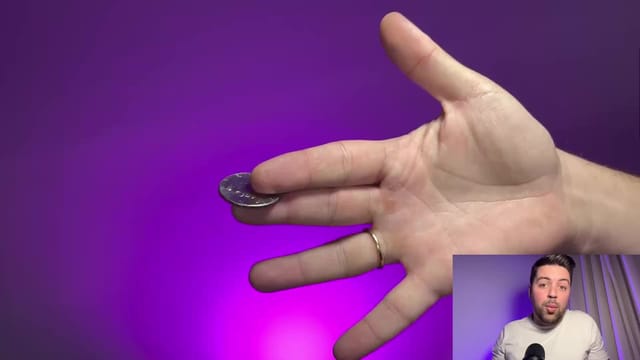
Downs Palm: retention and recovery
The Downs Palm is a concealment position that José Arcario presents as a resource to expand your technical repertoire. The explanation covers the entry, retention, and recovery of a coin.
Parlour and stage applications are discussed, such as The Miser's Dream. These references establish the usefulness of the position; the lesson develops the palm and not a complete coin production routine.
Placement and retention
The move starts with a coin pinched between the index and middle fingers. It shows how to bring it to the thumb zone and secure it using the involved contact points.
José accompanies the explanation with different views. Lateral coverage is part of what is studied, along with hand placement.
Recovering the coin
The exit uses the reverse path: the fingers approach, recover the coin, and extract it. The movement is repeated to follow the relationship between retention and recovery.
Its connection to a production is discussed, the broader work of which is outside the scope of this video.
You need an ordinary coin. Practice consists of recognizing the grip points, coordinating the entry and exit, and paying attention to the angle from which the hand is shown.
The goal is to incorporate a technical position into your handling, keeping clear the difference between learning the palm and later constructing an effect with it.