Flying linking rings: routine, handling, and staging
From linking rings to levitation
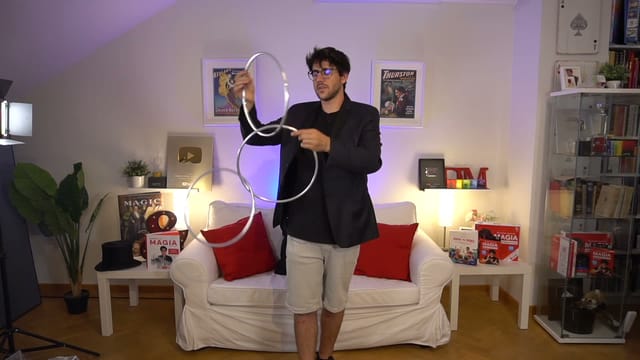
Borja Montón explains the flying rings routine he uses in his show, built upon Viktor Voitko's material and adapted with his own sequence and handling details. The act begins with recognizable linking and unlinking of the linking rings and evolves into flights, seemingly contactless separations, and a levitation of all three rings together.
The masterclass covers preparation, basic movements, the routine phase by phase, and exiting the stage. It includes commented demonstrations and observations arising from the instructor's work with the act.
Proper equipment and preparation
Conventional rings and lightweight rings prepared for this effect are compared. Borja explains why weight, finish, and the material's characteristics condition the sleights, and what limitations arise when practicing with normal rings.
You are taught how to prepare the thread, adjust its length to your wingspan, and organize your props before entering. The relationship with wardrobe is also studied: slipping, lapels, buttons, and accessories can affect handling. Preparation includes a backup ring ready to use if a problem arises before going on stage.
Ring control and basic movements
Learning begins with the spin, the flight between the hands, and tension control. It covers how to coordinate hands and body so the ring's movement is clear and does not look like a mechanical consequence of an obvious gesture.
The instructor compares movement variants and points out differences in position, orientation, and amplitude. He also develops a finger-spin flourish and recommends isolating movements to practice them before combining them into a sequence.
The routine, phase by phase
The explanation covers:
- The initial presentation and the first links and unlinks before introducing the levitation.
- The flourishes that connect the movements and set up the first flight.
- The crossing of the rings and the sensation that both participate in the movement.
- The seemingly contactless links and separations, paying special attention to slowness and body control.
- The incorporation of the third ring, the linking of the set, and the levitation of all three.
- The final separations, the bow, and packing up to leave the stage.
Each phase is explained with repetitions, variants, and corrections. The routine is then reviewed with dark thread, discussing the adjustments that appear during execution. This is a work-in-progress demonstration and explanation; it is not presented as an independent performance with an included musical track.
Pacing, clarity, and construction
Borja pays attention to audience orientation, the visibility of the rings, and the necessary pauses for each effect to be understood. He also comments on Willy Monroe's contributions to the two-ring movement and body posture.
Music is used to organize gestures, transitions, and moments of applause. The instructor encourages adapting the sleights to your own music and interpretation. He also examines a limitation of his closing: separating the rings after seeing them fly can have less impact than the preceding image. He explains the solution he uses and distinguishes that version from other ideas he is still developing.
Rehearsal, maintenance, and recovery
The class addresses specific situations: thread being too long, accumulated twists, snags, loss of orientation, and breakages. Ways to regain control are shown, and it is recommended to also practice mistakes while staying calm and preparing alternatives.
It is suggested to have a sequence of rings without levitation ready so you can continue if the mechanism fails, although that backup routine is not fully developed. It also explains how to coordinate the finale and the retrieval of props with the lighting technician and, when available, an assistant.
Lighting and requirements
The background, ambient lighting, front light, and visibility from different seats in the auditorium are analyzed. The adjustment is approached as a test in the actual space, with another person observing from the audience. The routine requires controlled stage conditions; it is not offered as an act that can simply be adapted to any parlor or celebration.
To practice the full version, you need three lightweight rings suitable for this system, appropriate thread, scissors, rehearsed wardrobe, and a close-up table or stand. Borja recommends a fourth ring prepared as a backup and uses rod-building-type thread. Normal rings and visible thread can be used to study some initial movements, but they do not replace all the routine's material.
It is helpful to be fluent with the linking rings and willing to practice coordination and technical adjustments. The recording lasts approximately one hour. It teaches Borja's personal version and working conditions; it does not include the props, music, or commercial material by Viktor Voitko.