Magical Rubik's Cube Solves
Magic with a regular Rubik's Cube
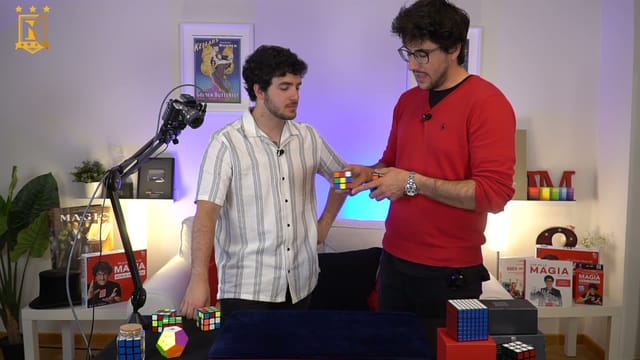
Adrián Marmac teaches several ways to present a cube solve as a magical effect, along with a color divination that can be used separately. The recording starts with a performance alongside Borja Montón and then breaks down the techniques with close-up explanations, repetitions, and presentation tips.
The effects are presented as tools you can pick and choose to combine. The performance sequence serves to show them in context; the instructor clarifies that this is not a fixed routine that must be performed in that exact order.
Color divination and handling an unexpected mix-up
A color force with the cube is explained, paying close attention to the delivery of instructions, spectator reactions, and natural handling. The effect can be presented as mind-reading without needing to solve the cube right after.
It is also offered as an out when someone genuinely scrambles the cube and you don't want to stop the show to solve it. Alternatively, they discuss how to accompany a skill-based solve with patter and easy-to-follow stages for the audience.
Progressive solve
Learn an adaptation of the progressive solve which the instructor attributes to Steven Brundage. It covers the setup, the handling sequence, and ways to show that the cube is getting progressively more solved.
Hand coordination, body orientation, and the necessary cover from different angles are examined. Adrián suggests leaving the final action to the spectator so they can participate in the climax. The explanation emphasizes practicing in parts and then linking the moves together, without telegraphing technical actions or concealing more of the cube than necessary.
Instant solve by tossing the cube
The mid-air solve is explained along with its setup sequence and the handling that accompanies the toss. A distinction is made between actions that can be done openly versus those that need to be blended into a larger gesture, working on the moment of displaying the cube before the effect.
Slow-motion and performance-speed demonstrations are included to tie the moves together with gaze, pauses, and rhythm. The goal is for the solve to look clean and startling, rather than just executing a flurry of rushed turns.
False shuffles and solve variations
False shuffle options based on repeated sequences and familiar moves are presented to preserve a setup while the cube appears to be thoroughly mixed. The masterclass uses notation and turn sequences; it does not teach standard cube-solving from scratch.
A solve inside a paper bag is also reviewed, along with a one-handed variation using continuous motion. An behind-the-back toss is discussed as an option requiring specific practice. To practice this toss, the instructor recommends starting with a juggling ball before using the cube.
Practice details include maintaining gesture continuity, avoiding rushing, checking angles, and waiting for the right moment to initiate each action.
Comparison of special gimmicks
In the final section, Adrián and Borja discuss commercial alternatives: the 360 and Cube Buster by Henry Harrius, and RD Insta and Rubicon by Gregory Wilson. They demonstrate the principles and possibilities of these gimmicks, compare solves and matches, and discuss differences in handling, appearance, and setup.
A distinction is made between effects suited for a fixed camera versus options appropriate for working live with a scattered audience. Real challenges regarding setup and adjustment during a performance are also highlighted, rather than painting all gimmicks as foolproof solutions.
This conversation serves as an orientation regarding possibilities rather than a complete tutorial for every routine. Cube in Bottle is shown as a potential closer and impossible object, but its method is expressly excluded from the explanation. You do not need to purchase these products to practice the core techniques with a regular cube.
Materials and prior knowledge
Prepare a standard, non-gimmicked 3×3 Rubik's Cube with smooth turning. For the bag solve, you will need a paper bag sized appropriately for the cube. The juggling ball is optional, intended for practicing the behind-the-back toss.
It is recommended that you know how to solve the cube and understand basic turning notation. Visual solves demand coordination, orientation control, and sequence practice; speedcubing speeds are not required.
The recording lasts approximately 46 minutes and combines technical explanations with a discussion on gimmicks. The opening speed demonstration highlights the instructor's skill, but it is not a speedcubing course. Physical gimmicks are not included.